Library
Browse and search books
5 novels found
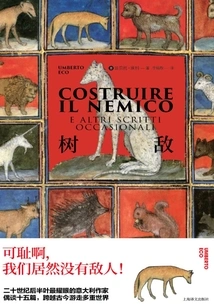
Make Enemies
Literature树敌
(italian) Umberto Eco
Umberto Eco, the most dazzling Italian writer in the second half of the 20th century, left the world with literary thoughts, in-depth exploration of semiotics, dialectical thinking on philosophy, exploration of religious ethics, and detailed comments on literary works. It is all-encompassing and logically rigorous; fifteen chapters of occasional talks span ancient and modern times and travel to multiple worlds. "Making Enemies" is a "collection of occasional talks" by Umberto Eco. The book contains fifteen articles. The content spans ancient and modern times and travels to multiple worlds. It integrates the writer's multiple identities into one book: From it, we can not only see the philosophical reflections and literary concerns of the scholar Eco, but also the The public intellectual Eco uses the past to satirize the present and criticizes current ills. There are clues of the creation of the novelist Eco, and there is also the old naughty Eco who writes about the life experience with his wonderful ideas. It is all-encompassing, allowing you to be shocked by Eco's talent and at the same time discover a country you have never reached.
Umberto Eco, the most dazzling Italian writer in the second half of the 20th century, left the world with literary thoughts, in-depth exploration of semiotics, dialectical thinking on philosophy, exploration of religious ethics, and detailed comments on literary works. It is all-encompassing and logically rigorous; fifteen chapters of occasional talks span ancient and modern times and travel to multiple worlds. "Making Enemies" is a "collection of occasional talks" by Umberto Eco. The book contains fifteen articles. The content spans ancient and modern times and travels to multiple worlds. It integrates the writer's multiple identities into one book: From it, we can not only see the philosophical reflections and literary concerns of the scholar Eco, but also the The public intellectual Eco uses the past to satirize the present and criticizes current ills. There are clues of the creation of the novelist Eco, and there is also the old naughty Eco who writes about the life experience with his wonderful ideas. It is all-encompassing, allowing you to be shocked by Eco's talent and at the same time discover a country you have never reached.
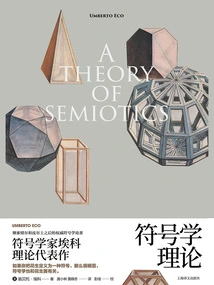
符号学理论(翁贝托·埃科作品系列)
(italian) Umberto Eco
"Theory of Semiotics" is the theoretical masterpiece of Italian semiotician Umberto Eco. It successfully constructed a theoretical system of general semiotics. It is the authoritative semiotics treatise after Saussure and Peirce and is highly respected in Western academic circles. The book is divided into five chapters, which respectively elaborate on the basic terms, concepts and theoretical systems of semiotics, and conduct creative explorations of "code theory" and "symbol production theory". This book provides the theoretical community with a classic theory of general semiotics, and Eco's lifelong research and creative path is undoubtedly the best example of the relationship between semiotics and writing, and even literary theory and writing.
"Theory of Semiotics" is the theoretical masterpiece of Italian semiotician Umberto Eco. It successfully constructed a theoretical system of general semiotics. It is the authoritative semiotics treatise after Saussure and Peirce and is highly respected in Western academic circles. The book is divided into five chapters, which respectively elaborate on the basic terms, concepts and theoretical systems of semiotics, and conduct creative explorations of "code theory" and "symbol production theory". This book provides the theoretical community with a classic theory of general semiotics, and Eco's lifelong research and creative path is undoubtedly the best example of the relationship between semiotics and writing, and even literary theory and writing.
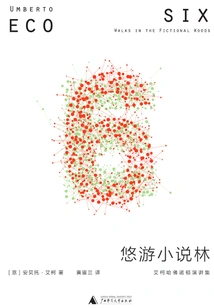
悠游小说林:艾柯哈佛诺顿演讲集
(italian) Umberto Eco
"Wandering in the Novel Forest" is a collection of six lectures from Umberto Eco's Norton Lectures at Harvard University. It is not only six novel theory classes, but also a guide to literary reading and writing. How does the text signal the search for the ideal reader? How does a reader read a novel correctly? How can you identify exemplary authors and decipher their textual strategies? In this book, Eco fully demonstrates his ability to turn boring semiotics and narrative theory into a kind of intellectual pleasure and mental enlightenment. With clinical precision, he uses concepts such as model readers and model authors, novel stories and plots, story time and narrative time, to peel off the technical aspects of the text, investigate the mysteries hidden in the form and technique of the novel, and then explore the relationship between novels and life, imagination and reality, as well as the deep reasons why people are fascinated by novels. Whether it's Nerval, Proust, Joyce, Dante, Alexandre Dumas, Agatha Christie, or Ian Fleming, Eco follows the instructions and guides readers to appreciate their artistic charm at his intellectual level while uncovering the mystery of these writers' works. He even allows readers to become his apprentices and get lost step by step in the deep and dense forest of the novel.
"Wandering in the Novel Forest" is a collection of six lectures from Umberto Eco's Norton Lectures at Harvard University. It is not only six novel theory classes, but also a guide to literary reading and writing. How does the text signal the search for the ideal reader? How does a reader read a novel correctly? How can you identify exemplary authors and decipher their textual strategies? In this book, Eco fully demonstrates his ability to turn boring semiotics and narrative theory into a kind of intellectual pleasure and mental enlightenment. With clinical precision, he uses concepts such as model readers and model authors, novel stories and plots, story time and narrative time, to peel off the technical aspects of the text, investigate the mysteries hidden in the form and technique of the novel, and then explore the relationship between novels and life, imagination and reality, as well as the deep reasons why people are fascinated by novels. Whether it's Nerval, Proust, Joyce, Dante, Alexandre Dumas, Agatha Christie, or Ian Fleming, Eco follows the instructions and guides readers to appreciate their artistic charm at his intellectual level while uncovering the mystery of these writers' works. He even allows readers to become his apprentices and get lost step by step in the deep and dense forest of the novel.
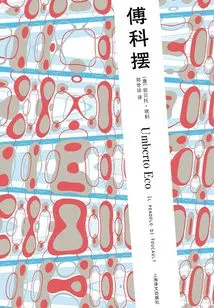
Foucault's Pendulum
General Fiction傅科摆
(italian) Umberto Eco
On the twenty-fifth anniversary of the publication of "Foucault's Pendulum", author Umberto Eco carefully revised the novel, added several illustrations, and rewritten chapters. This book is based on "Foucault's Pendulum" revised by Umberto Eco in 2013. In Milan in the 1970s, Dr. Casaubon, a scholar proficient in medieval history, and his two friends, Belbo and Diotallevi, senior editors of Garamon Publishing House, were responsible for publishing a set of "Hermes Series" aimed at making profits. The three partners claim to be knowledgeable and skilled, and in a playful spirit, they weave the many mysterious events, characters and associations circulating in history into a seamless "plan", almost "rewriting" and "rewriting" the entire world history. In order to make the "plan" more complete, they created a secret society: "Teleis".
On the twenty-fifth anniversary of the publication of "Foucault's Pendulum", author Umberto Eco carefully revised the novel, added several illustrations, and rewritten chapters. This book is based on "Foucault's Pendulum" revised by Umberto Eco in 2013. In Milan in the 1970s, Dr. Casaubon, a scholar proficient in medieval history, and his two friends, Belbo and Diotallevi, senior editors of Garamon Publishing House, were responsible for publishing a set of "Hermes Series" aimed at making profits. The three partners claim to be knowledgeable and skilled, and in a playful spirit, they weave the many mysterious events, characters and associations circulating in history into a seamless "plan", almost "rewriting" and "rewriting" the entire world history. In order to make the "plan" more complete, they created a secret society: "Teleis".
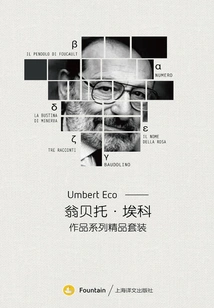
翁贝托·埃科作品系列精选套装(套装共6本)
(italian) Umberto Eco
This set contains a total of 6 books: "Trial Issue", "Foucault's Pendulum", "Baudolino", "Minerva Matchbox", "The Name of the Rose", and "The Dwarfs on the Dwarf Planet".
This set contains a total of 6 books: "Trial Issue", "Foucault's Pendulum", "Baudolino", "Minerva Matchbox", "The Name of the Rose", and "The Dwarfs on the Dwarf Planet".