Library
Browse and search novels
6 novels found

马洛伊·山多尔经典作品集(全六册)
(hungary) Malloy Sandor
Malloy Sandor wrote 6 beloved works throughout his life. Among them, "Confessions of a Citizen" is comparable to Proust's masterpiece "In Search of Lost Time" and is the first Chinese translation from Hungarian.

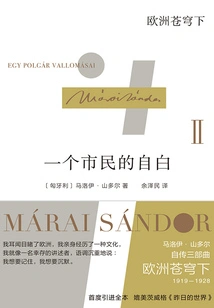
Confessions of a Citizen (maloy Sandor)
General Fiction一个市民的自白(马洛伊·山多尔作品)
(hungary) Malloy Sandor
It arose in the golden age of Hungarian capitalism. It is a special social class including aristocrats, celebrities, capitalists, bankers, middle class and dilapidated nobles. It is the "citizen class" in the novel. This is the confession of a "citizen", this is the last elegy sung to the bourgeoisie, this is a picture of the life of the emerging citizen class in Eastern Europe between the two world wars, this is a period of exile, loneliness and determination. As the representative work of Malloy Sandor, in terms of literary and artistic standards, "Confessions of a Citizen" is completely comparable to Proust's "In Search of Lost Time" and Thomas Mann's "The Buddenbrooks".

Love Disguised as a Monologue (maloy Sandor)
General Fiction伪装成独白的爱情(马洛伊·山多尔作品)
(hungary) Malloy Sandor
"Love Disguised as a Monologue" is Malloy's most beloved work written throughout his life, and is addressed to the true spiritual aristocrat. Four monologues, four parties recounting two failed marriages. The ex-wife was sitting in a dessert shop on the corner of the street, quietly watching her husband pack candied orange peels for his second wife. In the coffee shop, the husband, who came from a privileged background, recalled the half-pandering, half-sarcastic look in his second wife's eyes when she secretly observed him in bed. He regarded her as his true love, but his eyes extinguished all flames. The second wife, who had been her husband's maid, talked with her lover all night long. The closet full of socks, ties and books on the wall at her husband's house once made her feel that her hands were particularly dirty, and the ever-changing licorice smell on her husband's body made her feel nauseous. Many years later, the lover met her fugitive husband in a small bar in the United States and watched him disappear into the slums.

Candle Ember (work by Malloy Sandor)
General Fiction烛烬(马洛伊·山多尔作品)
(hungary) Malloy Sandor
In the empty manor, the owner, the old general, welcomed a rare visitor, an old friend who had once been acquainted with him. In the dim living room, the general and the visitor sat opposite each other with candles, talking all night long, remembering the general's long-lost wife, and judging a triangle relationship intertwined with love and friendship, loyalty and betrayal. Chaos and turmoil surged deep in the hearts of the two old friends, and the embers of lust and hatred continued to smolder. In a gripping and fierce argument, Malloy uses somber and elegiac words to remember the bygone era of empire, as well as the consequent disappearance of aristocratic virtue and gentlemanly friendship. The sadness when the Austro-Hungarian Empire faced the decline, and the wavering of people's traditional morality when the world order collapsed, are clearly reflected in the lines.

Confessions of a Citizen 3: I Wanted to Be Silent
General Fiction一个市民的自白3:我本想沉默
(hungary) Malloy Sandor
From the day Hitler entered Vienna, what fate has befallen the civilization of civil society? Why did Hungary lose its mind and go to the edge of the knife? Based on extensive and detailed observations, Malloy Sandor meticulously records and analyzes a series of key events related to the fate of Hungary: the Anschluss Day, the establishment and subversion of the Hungarian Soviet Republic, anti-Semitism in Nazi Germany, the siege of Budapest, and two important treaties that had a profound impact on the European political situation: the Treaty of Trianon and the Vienna Arbitration Award. Through writing that penetrates the back of the paper, he reproduces the secret struggle between domestic and foreign forces on the Hungarian political stage, and then examines the Hungarian nation at the center of the whirlpool. He questions the national and social missions that citizen class intellectuals should bear, and interprets the full weight of the word responsibility. He also gained a profound insight into the inevitable demise of citizenism through the tragic lives of three government prime ministers - Bertrand István, Telej Pal, and Baldosz Laszlo. He wanted to be silent, but in the end he couldn't. He wants to leave a testimony and let history become a mirror for the future.

Breaking up in Buda (maloy Sandor)
General Fiction分手在布达(马洛伊·山多尔作品)
(hungary) Malloy Sandor
In the early autumn afternoon, the young judge was reviewing the divorce case files for the next day and discovered that a couple were his old acquaintances. During the dinner, the judge fell into a long recollection of the ancient and solemn family: the judge's duties and gentleman's ethics passed down from generation to generation, love is erratic and fragile, and the family is maintained by self-denial and upbringing. The guests are in low spirits, the empire is disintegrating, World War II is imminent, and the era is confused and they don't know where to go. In the quiet study room of the apartment in the middle of the night, there have been uninvited guests. The husband nearly collapsed and claimed he had just killed his wife. He spoke passionately about his emotional life and complained about the relationship triangle that led to the failure of his marriage. After a long conversation all night long, his doubts about the judge and the torture peeled off the cocoons, gradually revealing the cruel truth about love and marriage.