Library
Browse and search books
3 novels found
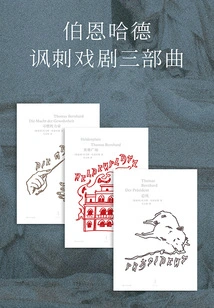
Bernhard's Satirical Drama Trilogy
Literature伯恩哈德讽刺戏剧三部曲
(austria) Thomas Bernhard
Paying attention to life and social reality in a critical way reveals absurdities and paradoxes that are different from Kafka's; using the ironclad spirit of intellectuals, he becomes the gadfly of society and the people. Classic plays by Thomas Bernhard, winner of the Lille Patzer Prize, the Austrian State Prize for Literature, the Büchner Prize, the Free Hanseatic City Bremen Prize, the Julius Camper Prize, the Anton Wildgans Prize, and the Franz Theodor Jockol Literary Prize. "The President": Bernhard's classic drama; a mockery of the madness of the world; behind the world is a solid and complex stage mechanism. "Heroesplatz": Bernhard's last play; a play that shocked the world and turned the whole of Austria into a stage. The Force of Habit: Bernhard's first comedy; Hannover Theater Prize, Best Play of the Year in Contemporary Theater; In a world without tolerance, every word is a mantra.
Paying attention to life and social reality in a critical way reveals absurdities and paradoxes that are different from Kafka's; using the ironclad spirit of intellectuals, he becomes the gadfly of society and the people. Classic plays by Thomas Bernhard, winner of the Lille Patzer Prize, the Austrian State Prize for Literature, the Büchner Prize, the Free Hanseatic City Bremen Prize, the Julius Camper Prize, the Anton Wildgans Prize, and the Franz Theodor Jockol Literary Prize. "The President": Bernhard's classic drama; a mockery of the madness of the world; behind the world is a solid and complex stage mechanism. "Heroesplatz": Bernhard's last play; a play that shocked the world and turned the whole of Austria into a stage. The Force of Habit: Bernhard's first comedy; Hannover Theater Prize, Best Play of the Year in Contemporary Theater; In a world without tolerance, every word is a mantra.
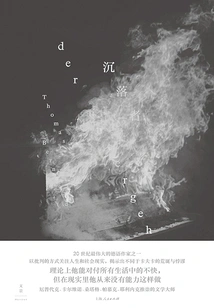
Sinker
General Fiction沉落者
(austria) Thomas Bernhard
Wertheimer's misfortune was that just as he passed Room 33 on the second floor of the Mozart Institute, Glenn Gould happened to be playing the Goldberg Variations there, playing the so-called aria. Wertheimer later told me his experience, saying that he stood in front of the door of Room 33 and listened to Glenn until the end of the aria. I understood then what kind of horror this was. This monologue novel describes three people's artistic pursuit of piano playing and their different life choices: one becomes a miracle, one sinks, and one turns to another path.
Wertheimer's misfortune was that just as he passed Room 33 on the second floor of the Mozart Institute, Glenn Gould happened to be playing the Goldberg Variations there, playing the so-called aria. Wertheimer later told me his experience, saying that he stood in front of the door of Room 33 and listened to Glenn until the end of the aria. I understood then what kind of horror this was. This monologue novel describes three people's artistic pursuit of piano playing and their different life choices: one becomes a miracle, one sinks, and one turns to another path.

Wittgenstein's Nephew: a Friendship
General Fiction维特根斯坦的侄子:一场友谊
(austria) Thomas Bernhard
In 1967, my friend Paul Wittgenstein (nephew of the famous philosopher Ludwig Wittgenstein) and I were living in a hospital in Vienna at the same time, me being treated for a lung disease and he being treated for psychiatry. I don't think it was a coincidence that we were suddenly hospitalized at the same time and once again nearing the end of our lives. But I also don't let this fact carry too much fate. I was in the Hermann ward, and the thought of my friend Paul in the Ludwig ward made me feel less lonely. I am not going to deceive myself anymore, I am not going to beautify anything, there is nothing that can be beautified, what is going on non-stop in this society and this world is to beautify everything, and in the most disgusting way.
In 1967, my friend Paul Wittgenstein (nephew of the famous philosopher Ludwig Wittgenstein) and I were living in a hospital in Vienna at the same time, me being treated for a lung disease and he being treated for psychiatry. I don't think it was a coincidence that we were suddenly hospitalized at the same time and once again nearing the end of our lives. But I also don't let this fact carry too much fate. I was in the Hermann ward, and the thought of my friend Paul in the Ludwig ward made me feel less lonely. I am not going to deceive myself anymore, I am not going to beautify anything, there is nothing that can be beautified, what is going on non-stop in this society and this world is to beautify everything, and in the most disgusting way.