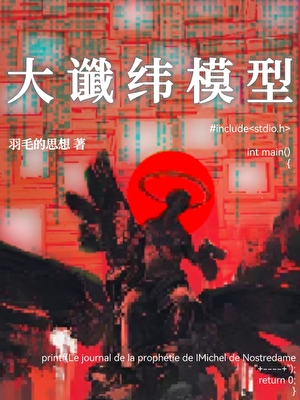
At three o'clock in the afternoon on September 2, 1991, a set of deciphering results broke the peace of the Nostradamus Prophecy Decryption Bureau. The protagonist learns that he will bring about the end of the world, and the whole world will be burned up in fire and plague. Soon after, the alignment machine was tampered with, and the Great Prophecy model was out of order... A series of magical realism events followed. As the true face of the prophecy was revealed, fate inevitably slipped towards the predetermined, and a doomsday crisis gradually approached...
Cryptography, ciphertext, plaintext, threshold-breaking, undecipherable prophecy model. Under layers of encryption, the deeper the incident goes, the more distorted the perception becomes, until it is impossible to distinguish the boundary between fantasy and reality; the closer we get to the truth, the weirder everything becomes.
Emotional cryptographers, freaks with prophetic powers, soldiers, electricians, astrophysicists... Everything is suspected, everything has a motive, everything is within the range of the oracle.
Good boy, tell me, who is the traitor who stole the fire?
Also known as "We Sit and Cry at the IBM Machine" and "White Cord"
Intention: In the struggle with fate, in the entanglement with the established, do not step into the subtle.
Reader comments
It's been a long time since I've read a book so heartily in Jinjiang. This book is really wonderful. I originally wanted to save it until the end, but it seems I can't save it anymore. So I'll just write down some of my current thoughts here. Please be careful if there are any spoilers involved.
The first is the work itself.
You can feel that the author's writing skills are profound and extensive, and the narrative description has a cinematic feel. In particular, the slow-motion description of the protagonist using deduction and some details are very vivid and real. And it creates a gloomy atmosphere in a totalitarian background. If any movie has its own tone, then I think the filter of this book (or this movie) is the cold and silent dark blue night, but the orange light of hope can still be seen between the pens.
At the same time, the narrative style of this book is calm and restrained, accurately shaping many characters, and the emotional expression of the words reaches the depths of the soul. For example, Poisson Bai, the contrast between the philosophical social beast and the fanatical messianism is very charming, and his continued weak state gives him a broken sense of beauty. Especially when he sees Poisson being stared at and feeling oppressed, he will have a grievance expression in his mind, which is simply arousing (cross out). And some settings always make me feel the author's dark humor and bad taste, such as the protagonist's birthday... But it is very fragrant and delicious. Please have more, thank you teacher.
Next is Luo Yue, who is also the character who impressed me the most. From the self-disciplined male mother, the guardian angel (dark male ghost), the loyal accomplice to the subsequent revelation of his identity, it feels unexpected but reasonable. The intertwining of control and protection is vividly reflected in him. Although he is good at training military dogs, in fact, he is the first to fall into trouble^ ^
Then there is Feng Baiji. Maintenance Superman can occasionally get Bai Bai's philosophical nonsense, or channel, and it feels like Bai Bai trusts him more than Luo Yue. And because of the setting, I was successfully misled by the author into thinking that he was a mole at first. Later, I just wanted to shout: Lao Feng, Lao Feng! In addition, although I haven't translated the Cantonese and Shanghainese spoken in the restaurant, I feel that Feng Baiji always has someone behind him. At least he should know some of Luo Yue's plans, and I don't know what he will do next.
Finally, there is Kong Ji, who has less description than the other three, but his growth and changes can also be seen in the details. I don't know what he will become in the future. Will the lonely and crystal-like young prophet be shattered to pieces after reflecting all his destiny, or will he be buried in the world? Looking forward to the subsequent plot.
In addition, let me add some of my own feelings after reading it, that is... Don't worry about the broken prophecy, you four are better off living your lives well than anything else.
Especially Luo Yue, don't look for that homeless guy! Don't even vote! The director is about to lose his memory. Go up and catch him and say that I am your husband who has been missing for many years! (Bushi) I really didn't say this was for you, so I asked:
When you saw him lying in a pool of blood, did your heart burn like the scorching sun?
Did you feel a little moved when you saw him choking on the astringent cigarette and laughing softly?
You know that he doesn't have much time left, so when you tell him fairy tales that you can't believe under the ginkgo tree, do you feel powerless?
No matter how much you pray, you can't save it, no matter how you modify it, you will only reach your destined fate in the end. Even if you want to be a mole, you just want to get a chance of treatment, but you can only watch the person you care about most begin to fall apart. What is more desperate than getting to know each other again is to firmly believe that you can go on a road with no end in sight, even if the price is to keep returning to the starting point... I won't say it, I won't be knifed (put on sunglasses) (pretend to be calm)
In addition, regarding Mei Xi, I have analyzed everyone before, but it is difficult to think of a reasonable way to describe her. In this book, she is more of a symbol, a stable anchor, and the novocain of Bai Poisson's wandering consciousness, opposite to the "electronic angel". But after reading the book, I can always think of her indifference and departure, which makes people feel a little sad. Maybe it's because I understand her transparency and the sadness that cannot be contained under the transparency. Perhaps she decided to die on the day she first met Bai Poisong, but she still accepted the theater invitation and saw the sunrise the next day. Although she was destined to be destroyed no matter what kind of changes, she did not know that the extra period of time she lived would affect Bai Poisong for the rest of his life and become the Eden of his spiritual world. Just like everyone's efforts to save Bai Poisong, they may not be able to prevent his memory from fading, but they will make Bai Poisong's personality have an extra part - love and affection in a broad sense, unique to human beings, and this feeling will definitely be passed on to someone in another way, transcending gods and fate.
Maybe it would seem a little self-motivated to say this, but if modifying destiny is already included in destiny, then is such a destiny still the so-called destiny? In other words, does destiny include modified destiny, or does modified destiny include destiny? This is my different view on the fatalism in this book. Of course, this is just my personal opinion, not complete or substantial, just a little thought.
Finally, I would like to thank you for writing this book carefully. Not only is it excellent in all aspects, but it also incorporates elements from many excellent movies, TV shows, and books. You can't help but smile when you read some parts. Perhaps because of its literary temperament and partial stream-of-consciousness characteristics, this book is relatively unpopular in online literature, but gold will always shine one day, and I hope more and more people can discover this treasure.

It's been a long time since I've read a book so heartily in Jinjiang. This book is really wonderful. I originally wanted to save it until the end, but it seems I can't save it anymore. So I'll just write down some of my current thoughts here. Please be careful if there are any spoilers involved. The first is the work itself. You can feel that the author's writing skills are profound and extensive, and the narrative description has a cinematic feel. In particular, the slow-motion description of the protagonist using deduction and some details are very vivid and real. And it creates a gloomy atmosphere in a totalitarian background. If any movie has its own tone, then I think the filter of this book (or this movie) is the cold and silent dark blue night, but the orange light of hope can still be seen between the pens. At the same time, the narrative style of this book is calm and restrained, accurately shaping many characters, and the emotional expression of the words reaches the depths of the soul. For example, Poisson Bai, the contrast between the philosophical social beast and the fanatical messianism is very charming, and his continued weak state gives him a broken sense of beauty. Especially when he sees Poisson being stared at and feeling oppressed, he will have a grievance expression in his mind, which is simply arousing (cross out). And some settings always make me feel the author's dark humor and bad taste, such as the protagonist's birthday... But it is very fragrant and delicious. Please have more, thank you teacher. Next is Luo Yue, who is also the character who impressed me the most. From the self-disciplined male mother, the guardian angel (dark male ghost), the loyal accomplice to the subsequent revelation of his identity, it feels unexpected but reasonable. The intertwining of control and protection is vividly reflected in him. Although he is good at training military dogs, in fact, he is the first to fall into trouble^ ^ Then there is Feng Baiji. Maintenance Superman can occasionally get Bai Bai's philosophical nonsense, or channel, and it feels like Bai Bai trusts him more than Luo Yue. And because of the setting, I was successfully misled by the author into thinking that he was a mole at first. Later, I just wanted to shout: Lao Feng, Lao Feng! In addition, although I haven't translated the Cantonese and Shanghainese spoken in the restaurant, I feel that Feng Baiji always has someone behind him. At least he should know some of Luo Yue's plans, and I don't know what he will do next. Finally, there is Kong Ji, who has less description than the other three, but his growth and changes can also be seen in the details. I don't know what he will become in the future. Will the lonely and crystal-like young prophet be shattered to pieces after reflecting all his destiny, or will he be buried in the world? Looking forward to the subsequent plot. In addition, let me add some of my own feelings after reading it, that is... Don't worry about the broken prophecy, you four are better off living your lives well than anything else. Especially Luo Yue, don't look for that homeless guy! Don't even vote! The director is about to lose his memory. Go up and catch him and say that I am your husband who has been missing for many years! (Bushi) I really didn't say this was for you, so I asked: When you saw him lying in a pool of blood, did your heart burn like the scorching sun? Did you feel a little moved when you saw him choking on the astringent cigarette and laughing softly? You know that he doesn't have much time left, so when you tell him fairy tales that you can't believe under the ginkgo tree, do you feel powerless? No matter how much you pray, you can't save it, no matter how you modify it, you will only reach your destined fate in the end. Even if you want to be a mole, you just want to get a chance of treatment, but you can only watch the person you care about most begin to fall apart. What is more desperate than getting to know each other again is to firmly believe that you can go on a road with no end in sight, even if the price is to keep returning to the starting point... I won't say it, I won't be knifed (put on sunglasses) (pretend to be calm) In addition, regarding Mei Xi, I have analyzed everyone before, but it is difficult to think of a reasonable way to describe her. In this book, she is more of a symbol, a stable anchor, and the novocain of Bai Poisson's wandering consciousness, opposite to the "electronic angel". But after reading the book, I can always think of her indifference and departure, which makes people feel a little sad. Maybe it's because I understand her transparency and the sadness that cannot be contained under the transparency. Perhaps she decided to die on the day she first met Bai Poisong, but she still accepted the theater invitation and saw the sunrise the next day. Although she was destined to be destroyed no matter what kind of changes, she did not know that the extra period of time she lived would affect Bai Poisong for the rest of his life and become the Eden of his spiritual world. Just like everyone's efforts to save Bai Poisong, they may not be able to prevent his memory from fading, but they will make Bai Poisong's personality have an extra part - love and affection in a broad sense, unique to human beings, and this feeling will definitely be passed on to someone in another way, transcending gods and fate. Maybe it would seem a little self-motivated to say this, but if modifying destiny is already included in destiny, then is such a destiny still the so-called destiny? In other words, does destiny include modified destiny, or does modified destiny include destiny? This is my different view on the fatalism in this book. Of course, this is just my personal opinion, not complete or substantial, just a little thought. Finally, I would like to thank you for writing this book carefully. Not only is it excellent in all aspects, but it also incorporates elements from many excellent movies, TV shows, and books. You can't help but smile when you read some parts. Perhaps because of its literary temperament and partial stream-of-consciousness characteristics, this book is relatively unpopular in online literature, but gold will always shine one day, and I hope more and more people can discover this treasure.