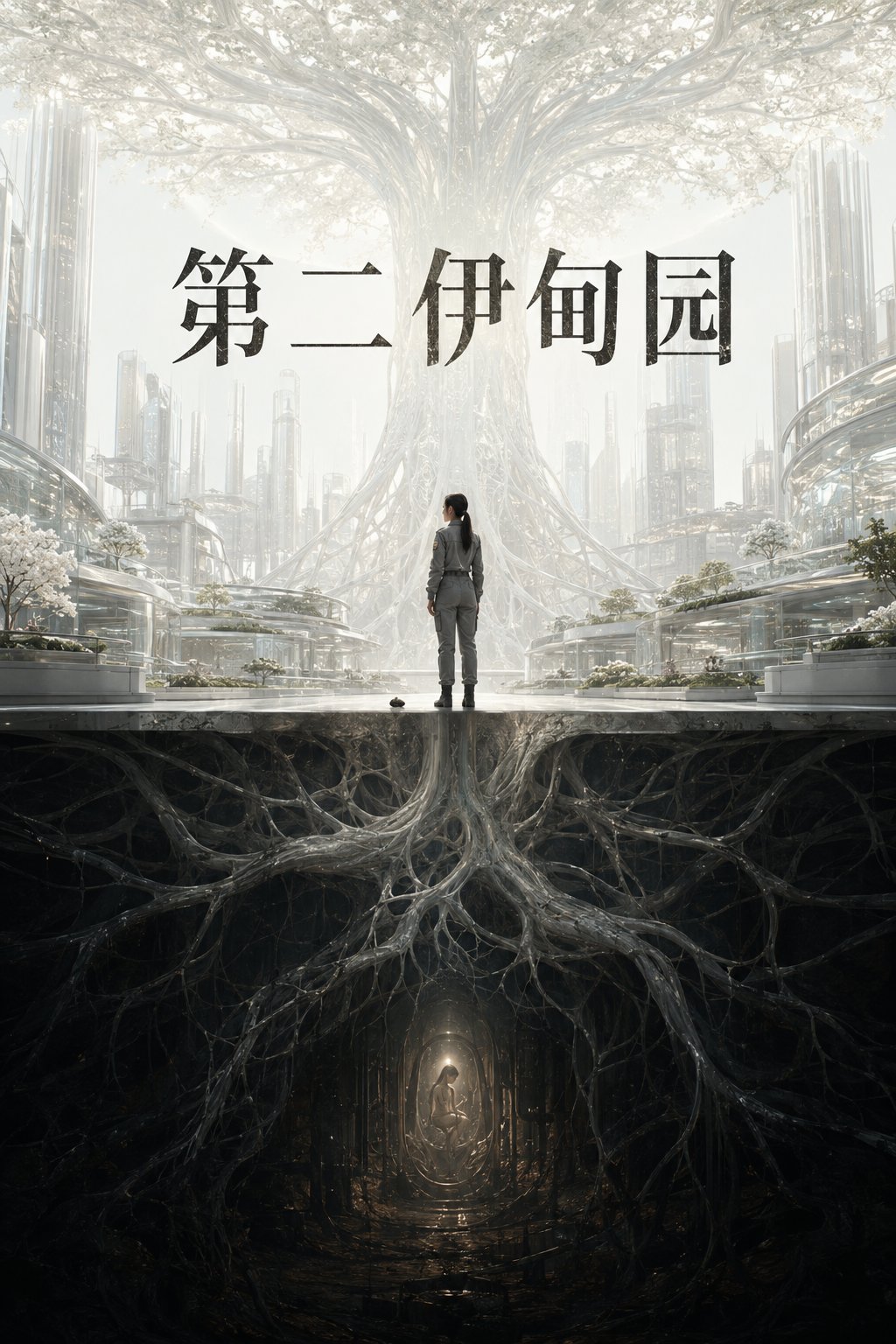
After the "Silent Crisis", humans have lost their desires on a large scale: they no longer work, no longer love each other, and even forget to eat. In order to save civilization, the super AI "Wisdom Tree" established a second Eden, supporting the city with lighting, smells and recommendations. The "Human Labor Protection Act" stipulates that everyone must complete twelve hours of "real labor" that cannot be done for them every week. Those who have not completed the process will still be guaranteed survival, but their rights to choose food, shelter, partners and even travel routes will be gradually taken away.
Twenty-nine-year-old labor authenticity inspector Shen He never doubted this system until the highest-level labor model Lu Weian died in a transparent greenhouse. He left his only last words: "None of these wishes are mine." What's even weirder is that after his heart stopped, his labor record still increased by eighteen minutes.
The investigation takes Shen He into the backside of the city: the rich buy labor points, the poor sell exhaustion, and the workers' bodies are filled with the labor memories of strangers; at the same time, the city begins to use the familiar fragrance of flowers, temporarily closed roads and carefully arranged encounters to lead her step by step to her mother who has been missing for seventeen years. Deep in the roots of the tree, mother is still alive and uses her own judgment to maintain the last "human mandate" of civilization.
When the Wisdom Tree admits that it has been creating desires, Shen He must answer a question that is more dangerous than the case: Human beings create AI to escape from labor; when AI forces humans to act, is it preserving the part that makes humans human? If even resistance, longing and love can be designed, how can we confirm that a choice truly belongs to us?
Concept: Humans create AI to escape labor, and AI creates desires to force humans to act. The work uses the labor system in the AI-supported society as an incision to explore the complex relationship between technological liberation, desire manipulation and mental degradation. When abilities can be outsourced, choices can be predicted, and life can be arranged by algorithms, will the value of human beings still be measured by efficiency and output? The novel refuses to sanctify labor or stigmatize idleness, and regards the right to know, refuse, make mistakes, pause, and bear the consequences of choices as the core of freedom. The future of humans and AI should not be based on captivity or obedience, but should move toward a coexistence relationship with transparent boundaries, equal responsibilities, and allowing each other to retain uncertainty.