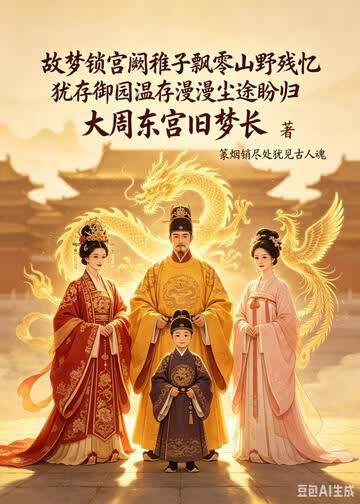
The Old Dream Is Locked in the Palace, the Child Is Wandering in the Mountains and Fields, and the Remaining Memories Are Still There. the Warmth of the Royal Garden Is Long, and the Long Dusty Journey Is Longing to Return to the East Palace of the Great Zhou Dynasty. the Old Dream Is Long.
故梦锁宫阙稚子飘零山野残忆犹存御园温存漫漫尘途盼归大周东宫旧梦长
by Wherever the Seal Incense Is Gone, the Souls of the Ancients Can Still Be Seen (篆烟销尽处犹见古人魂)
Request a translationStats
Tags
Synopsis
Xiao Chengze, the crown prince of the Great Zhou Dynasty, was only five years old and had been missing for two and a half years. Deep inside the palace, Emperor Xiaozhuang Ting sealed off the country's border and devoted all his efforts to search for the whereabouts of the prince. People inside and outside the court were in panic, and no one knew whether Zongzi's life or death was unknown. In the barren mountains and ridges, he lost all his memories of the past and was rescued by Grandma Li who had lost all her family and wanted to end her remaining life. The former noble Prince of the East Palace changed his name to Li Nian'an and lived in seclusion in a rural farmhouse, living with simple meals. Only a fragmented afterimage remained in his mind - the tender scene of his eldest brother Xiao Chen'an running to comfort him when he fell on the bluestone in the imperial garden, but his brother's face was always hazy and difficult to distinguish. The five-clawed dragon-patterned jade pendant at his waist is his only remaining connection with the royal bloodline. On one side is the endless search in the palace and the endless undercurrent of power; on the other side are the dull fireworks in the mountains and countryside, where ignorant children guard incomplete old dreams. When the dusty memories slowly loosen, when the threads of fate are entangled again, the lost prince will finally face his own identity. Between family, country and warmth, he will encounter the destined fate, find the lost family affection, and also rush to a love that has ups and downs. Purpose: This fictional palace romance unit story takes the missing prince Xiao Chengze of the Great Zhou Dynasty and accidentally wanders into the mountains and loses his past memories as the core clue. It combines the incompleteness of family love, the drift of fate, the redemption of goodwill, the struggle of memory and identity, and the pursuit of warmth and home. As the deep core, it also lays out the strong contrast between the two completely different worlds of the temple and the countryside. Under the shell of the cute baby group pet, it explores what is a real home, what is the bond of blood, what is the tenderness of human nature in suffering, and also lays the spiritual foundation for the subsequent love line. The first level of the story is the separation of memory and identity: noble blood does not equal a complete life. Xiao Chengze was born as the prince of the East Palace of the Great Zhou Dynasty. He was the prince that Emperor Xiao Zhuangze longed for throughout the country. He wore a five-clawed dragon jade pendant that symbolized imperial power, giving him a noble royal status. But a mysterious disappearance and amnesia made all the glory of the royal family come to nothing. He doesn't remember the palace, his father, or the responsibilities of the crown prince. There is only a fragmented memory of the royal garden in his mind - only Xiao Chen'an, his brother who died early, came to comfort the fragment of warmth that fell over him. His identity is the label given to him by the outside world, and the jade pendant is the physical evidence to prove his origin, but these cannot fill the empty memory of a child. When he woke up in the barren mountain, he was no longer the prince Xiao Chengze, but just a young boy named Li Nianan who had nothing and no idea where he came from. The work raises the question: Can blood, status, and glory define a person? Even though he is destined to be a prince, after losing his memory, he is first of all just a five-year-old child who is afraid of the cold, longs for companionship, feels pain and is confused. Everyone in the temple is persistently looking for "Prince Xiao Chengze", but the only person alive in the mountains and fields is Li Nian'an, who needs food and company. The tear between his external identity and his inner self runs through the beginning of the story, and also lays the foundation for his subsequent inner conflict when he returns to court and faces his true life experience. The second level of intention is two-way redemption in suffering, and the goodwill of ordinary people at the bottom is enough to resist the desperate situation of fate. The encounter between Grandma Li and Xiao Chengze helped each other in desperate situations. Grandma Li has experienced famine and catastrophe, her children and grandchildren have all starved to death, and she has made plans to spend the rest of her life; Xiao Chengze lives in the barren mountains, skinny as a stick. If no one finds him, he will be buried in the cold nights of the mountains and the claws of wild beasts. Both of them are poor people who have been severely abandoned by fate. It's not just the old man giving charity and taking in the orphans, but two lonely lives holding on to each other. Grandma Li gave the dying child a chance to live and a simple love; Xiao Chengze's appearance extinguished Grandma Li's desire to die and gave the desperate old man the hope of living again. There are no fine clothes and fine food, only wild vegetables and rough chaff, and dilapidated earthen houses. But this kind of goodwill from ordinary people without utilitarianism and no regard for status is the first warmth in the life of the amnesiac prince. Compared with the hidden plots surrounding the crown prince's position in the palace and the thoughtful searches of the court officials, the kindness of the old woman in the countryside does not have any intentions. She does not know the true identity of the child, does not covet the wealth of the dragon-patterned jade pendant, and simply cannot bear the death of a little life out of her own heart. The story wants to express that nobility may not be born in the palace. The brilliance of human nature is often hidden in the suffering at the bottom. Salvation is never a one-sided charity. Lonely souls can comfort and support each other. The third level of intention, the incomplete fetters of family ties: the unknown parting, the obsession buried deep in the heart. When Xiao Chengze was two years old, he met his brother Xiao Chenan in the Imperial Garden. Those were the only fragments of his remaining memories. Later, Xiao Chenan died at the age of four, and everyone in the palace deliberately concealed it. The missing Xiao Chengze never knew that his brother had passed away. In his vague remaining young mind, the warm presence of his brother who would come over to comfort him was the only mental thought he could hold on to after losing his memory. He repeatedly wanted to see his brother's face clearly, secretly looking forward to seeing him again. This memory is incomplete, blocked by time, death, and separation. On one side, deep inside the palace, Emperor Xiao Zhuangting was suffering from the pain of losing his eldest son at an early age, and was struggling to find his missing second son. The emperor controlled thousands of miles of land, but could not keep his two young children. The imperial power was supreme, but he could not withstand the separation of life and death; on the other side was Xiao Chengze, who was living among the people, carrying a yearning that no one responded to, not knowing that the person he missed was no longer alive. The story explores the regrets of family love: many partings are silent, and young people have no time to say goodbye properly, and some thoughts are destined to have no response. The concern that is connected by blood, even if it is amnesia or distance, will still be hidden in the heart and become a long-lasting spiritual imprint in the character's heart. This softness buried in the heart also shapes the gentle and affectionate character of the male protagonist, paving the way for his cherished and single-minded nature in his future love. The fourth level of conception, the contrast between the temple and the mountains, what is the true destination and what is home. The imperial court of the Great Zhou Dynasty mobilized the whole country to block the checkpoints and search for the prince everywhere. The imperial palace is Xiao Chengze's legal home. There was his father, the Eastern Palace, his crown prince position, and countless splendor and wealth. But at this moment, Xiao Chengze knew nothing about it. To him who had lost his memory, the magnificent palace was just a completely unfamiliar place. However, the dilapidated and simple country house, coarse cloth clothes, wild vegetables and coarse grains, because of Grandma Li's company, became the "home" in Li Nian'an's heart after losing his memory. The story raises the question: Is home built by identity, palace, and blood, or is it composed of companionship, love, and stability? As the story progresses in the future, the male protagonist will eventually face the choice of whether to return to the East Palace of the Imperial Court, which belongs to the prince Xiao Chengze, or to miss the warmth he gained as Li Nianan in the mountains and wilderness. In the court, the position of prince is accompanied by power struggles and the shackles of responsibility; in the countryside, there are ordinary days of peace and stability but lack of supplies. The pull between two lives and two destinations constitutes the core conflict of the unit. Power can bring back a prince, but it may not be able to easily repair a young heart that has already taken root in the mountains. The fifth level of intention is for readers under the age of 18: stick to tenderness in suffering, wait for memory and truth, believe in the warmth of the world, and pave the way for the core of love. A narrative for teenagers, without being overly dark. Even if there are disasters and famines, separation of flesh and blood, and the tricks of fate, the purity of children's perspective is still protected. Even if the male protagonist encounters great misfortune and loses his memory, he still remains kind and soft. He knows how to sympathize with the grief of the elderly and is not greedy for vain wealth. All he longs for is companionship and peace. The name "Nian'an" itself is the spiritual symbol of the story - in troubled times, the simplest wish of the human heart is to think of peace. At the same time, it also lays the spiritual foundation for the romance line: the male protagonist experienced loss, wandering, and scarce warmth when he was young, and he knows what it is like to be alone. Therefore, when he grows up and faces love, he knows how to cherish, understand empathy, and understand what it means to never leave. He has seen the goodness of human nature, and in the future he will see the treacherous nature of people in the court. Growing up between prosperity and suffering, he will neither become arrogant and cold-blooded because of his royal status, nor will he indulge in the mountains and wilderness and evade responsibility. The story also conveys value: fate can take away memories, glory, and displacement, but it cannot take away people's inner yearning for warmth, concern, and return; even if the past is broken, people can still live well by relying on the goodwill of the present. The sixth level of intention is the impermanence of fate and the meaning of waiting. After two and a half years of disappearance, the emperor could not be found. The child lost his memory and lived among the people. A jade pendant with a dragon pattern sealed the entire past. The truth is buried, and the memory is obscured by the fog. Everyone is waiting: the emperor is waiting for the prince to return, Xiao Chengze is subconsciously waiting for his memory to wake up and his brother in his memory, and Grandma Li is waiting for her child to grow up safely. The story acknowledges that fate is full of uncertainty, not all partings can be fulfilled immediately, and some truths will take a long time to be revealed slowly. The form of the unit article corresponds to this long wait. Each unit story is not only the male protagonist's growth experience among the people, but also the process of piecing together the memory fragments bit by bit and touching the truth of his life experience. It does not pursue a happy reunion in one fell swoop, but shows that even if the road ahead is unclear, people should still have hope and live seriously.
More by this author
 Prosperous Jin City, Love and Edge: Lu Chenyuan, Su Zhiyuan and Her Adorable Triplets Put an End to Rumors and Hold Hands to Go to the Beautiful Mountains and Rivers of the World Together.
Wherever the Seal Incense Is Gone, the Souls of the Ancients Can Still Be Seen
大
Prosperous Jin City, Love and Edge: Lu Chenyuan, Su Zhiyuan and Her Adorable Triplets Put an End to Rumors and Hold Hands to Go to the Beautiful Mountains and Rivers of the World Together.
Wherever the Seal Incense Is Gone, the Souls of the Ancients Can Still Be Seen
大 Dayin Palace Tells the Story of the Aristocratic Family's Legitimate Daughter and the Plot of the Amnesiac Prince.
Wherever the Seal Incense Is Gone, the Souls of the Ancients Can Still Be Seen
雨
Dayin Palace Tells the Story of the Aristocratic Family's Legitimate Daughter and the Plot of the Amnesiac Prince.
Wherever the Seal Incense Is Gone, the Souls of the Ancients Can Still Be Seen
雨 The Rain Falls on the Rich Family, the Young Dragon Loses His Memory, the Prime Minister's Mansion Originates from the Half-Life Dream of an Imperial Concubine
Wherever the Seal Incense Is Gone, the Souls of the Ancients Can Still Be Seen
The Rain Falls on the Rich Family, the Young Dragon Loses His Memory, the Prime Minister's Mansion Originates from the Half-Life Dream of an Imperial Concubine
Wherever the Seal Incense Is Gone, the Souls of the Ancients Can Still Be Seen