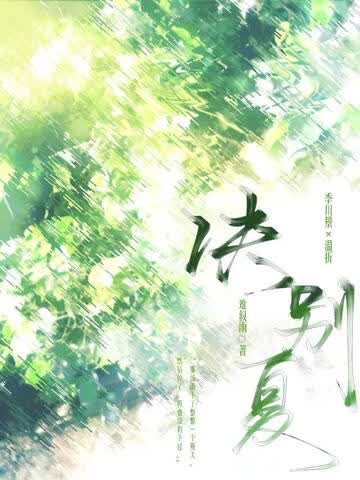
Farewell to Summer
诀别夏
by It's Hard to Tell the Rain (难叙雨)
- Status
- Ongoing
- Length
- 2k Words
- Genre
- Danmei (BL)
- Era
- Modern Era
- Updated
- 5mo ago
- Source
- JJWXC
Stats
Tags
- ThemeLove
- POVDual POV
- Age18+
- Angst
- Campus
- Dialogue-Style
- Teenage Years
Synopsis
The ancient Greeks said that man was originally a complete spherical creature. After being split in half by the gods, he spent his life looking for his other half. Wen Zhe couldn't recognize the face. In this high school campus that relies on face recognition, he relies on voice, posture, and details to identify everyone. Ji Chuanjing was the stranger who handed him an umbrella on a rainy day - he remembered his voice, his bad taste in patting his left shoulder while standing on the right, and the small mole in his palm, but he could not see his face clearly. It rained a lot that summer, and the sycamore trees were so green that they looked like they were dripping with paint. They met again and again in the cafeteria, library, and Wutong Road, and each time Ji Chuanjing used different ways to make him "recognize" himself—telling him a bunch of illogical gibberish to tease him, putting ice mineral water on his arm, and quietly walking with him back to the dormitory in the dusk. He remembered every word Wen Zhe said, but he was not asked to remember his own face. But summer is over. Ji Chuanjing transferred to the north. Like a sudden rainstorm, it fell violently and stopped simply. Purpose: To explore the nature of "seeing" and "completeness" through an encounter and loss in midsummer - real perception is never completed on the retina, but deep in the texture of memory. Face blindness is a metaphor: what we recognize throughout our lives is never the faces of others, but the details that are more permanent than the faces - the rhythm of the voice, the temperature of the palms, the posture of walking, the angle when a person tilts the umbrella handle for you. When these details are tempered into amber by time, that person's existence can no longer be erased, even if you have never really "see" him. The story explores the paradox of love: we long for completeness because of our incompleteness, but are often torn apart by fate at the moment when we are about to touch completeness. The legend of the Orb Man runs throughout - those who are split open are doomed to wander for life, but wandering itself may be the answer. What matters is not whether you have found your partner, but that during the search, you have recognized a person so deeply that he has become the coordinate system for your perception of the world. The heavy rain in summer will stop, the greenery of the parasol trees will fade, and people will leave, but the feeling of being soaked by the rain, the names written on the palms, and the temperature of the shoulders touching when two people huddle under an umbrella will remain in your life like scratches and become the yardstick by which you identify all subsequent encounters. The tragedy is not separation, but - he has been here and gone, but his presence makes it impossible for you not to think of him on any rainy day. This is a gentle and cruel enlightenment: love makes people complete, but the separation after completion is more painful than the initial incompleteness. The reason why people still love is because those remembered details have grown into a part of themselves.