"This imperial court is not very good, but how can Liangshan, which slaughters whole families and kills young sons, be any better?"
Abstract copy:
Lin'an TV: Ms. Feng, could you summarize in one sentence your experience of traveling from Liangshan to Bianjing and finally returning to Jiangnan in the first half of your life?
Feng Yunzhi: For ten years, I have been paying the price for my lustful obsession as a girl (looking at my still handsome husband next to me). Fortunately, I have always eaten well.
Concept copy:
Many years later, Hua Rong dreamed that he abandoned his wife and children and committed suicide in front of Songjiang's tomb in Liao'erwa, which scared him into cold sweats all his life.
He hugged his wife who woke up in a daze and felt a little relieved.
Over the years, every time when he was almost sliding down the road of "brotherly loyalty", there was always a hand that gently but stubbornly grabbed him, pulling him back to the world of fireworks, to the reality of having children around his knees, books and tea scented.
"Chilxin, thank you."
"Idiot. It wasn't me who held you back. It was the choice we both made to follow our hearts. I love you, so I don't want you to become a sword in the hands of others. And you care about me, the children, and true morality and gentleness. So you will listen, think, and choose another path."
Serious copywriting:
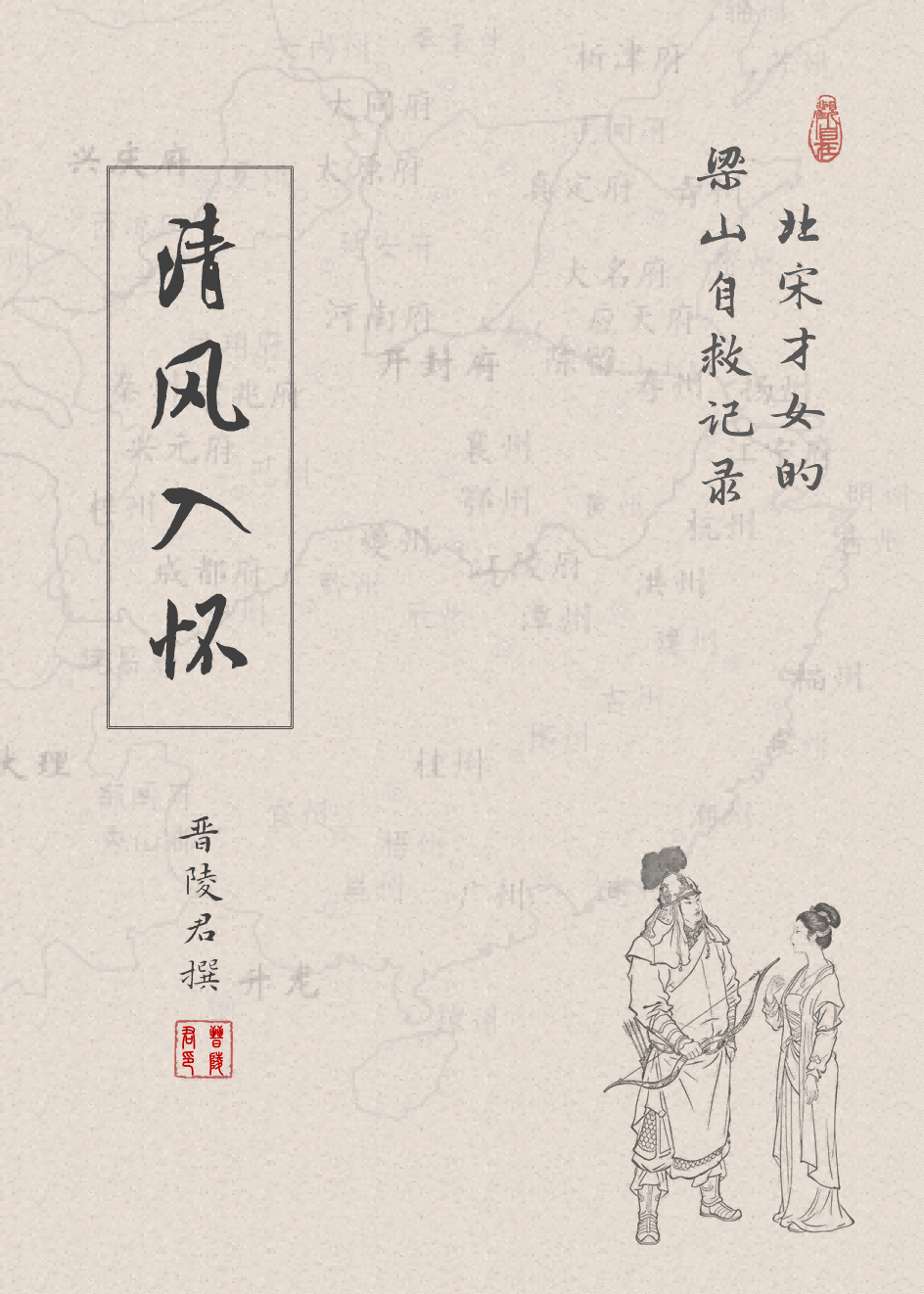
In the sixth year of the Zhenghe reign of Emperor Huizong of the Song Dynasty, Feng Yunzhi, the great-granddaughter of Feng Jing, the champion of the Renzong Dynasty, was rescued by Hua Rong, the Zhizhai of Qingfeng Village, on her way to visit relatives after her father's death. From then on, this tasseled lady was forced to get involved in the wild world of Liangshan.
She is proficient in literature but is out of place, and she sheds tears in fear of the bloody plot behind "Xingdao". She settled down with pen and ink, read and lectured, just to keep the balance in her heart, remember that people are kind, never hurt the innocent, and open up a world for her husband and children in troubled times.
From Qingfengzhai to Liangshanbo, from Daming Mansion to Bianjing City, recruiting troops, conquering the Liao Dynasty, and pushing for power - she has always been a talented prime minister. With her understanding of society and people's hearts, and her family network and political resources, she gradually dragged her husband back to that stable and orderly life.
Demining in advance:
It is a non-shuang novel. The heroine always takes the standpoint of the scholar-bureaucrat class and continues to criticize Liangshan's massacre of innocent people, forced marriages, and indiscriminate killings.
From a micro-historical perspective, there are many textual researches on official positions/customs/geography, and strive to conform to historical logic, but there will be a dramatic treatment.
The general plot of the original work will not be changed, but a few characters (Hu Sanniang, Xu Ning, Qin Ming, etc.) Will be slightly saved.
The deconstruction of the original work can represent the face of Yang Shui's character, but it has nothing to do with the film and television settings. The dark sides of Song Jiang, Wu Yong and others are not tabooed at all (character fans should be careful).
The emotional line is slow and delicate, the story of multiple marriages, daily life, HE.
Mission: Life should not be trampled on, protect the glimmer of humanity
Reader comments
At this point in writing, my attitude towards Liangshan has been very clear.
I don't like Liangshan, not because I don't like everyone in it, but because I don't like this form of social organization and this cultural atmosphere.
My story is very small, always unfolding in a small family and a small yard, but I hope to show a broader society and a more profound era.
Therefore, I also considered everything in the character setting of the male and female protagonists.
——————————————
Why set such an origin, character, and experience for the heroine? Because I hope to better express my understanding of Liangshan, Jianghu, and the peasant uprising through her.
She must be a woman with a delicate mind and rich emotions in order to experience first-hand the malice of this man's world towards women.
She must have a prominent official background and excellent intellectual literacy, so that she can be familiar with the operating rules of the upper class, and she must have enough political vision to see problems from a high-level perspective (so that some criticism from a historical perspective can come out of her mouth)
But she cannot be of too high a family background, otherwise she will not interact with Hua Rong, will not see the pain Gao Qiu and Zhu Meng and others have inflicted on the common people, and will not have disgust and criticism of this regime (she needs to have the confusion and confusion of a young bourgeoisie, not the peace and self-consistency of a big noble)
Therefore, I created a heroine who, after several dynasties of fame, is the daughter of a middle-level local official. She spent her girlhood in the south of the Yangtze River and grew up in abundant love. The superposition of these elements can combine family glory, political vision, idealism, criticism of bad governance, and love for life into one character. From her, we can get a glimpse of the changes in the upper class society in the middle and late Northern Song Dynasty.
The origins and experiences of Hua Rong and the heroine are completely different. The reason why I chose him as the male protagonist (of course Teacher Xiu Qing's handsome appearance is an important reason, and I love the horse archers) is because his ending completely made me feel like "a beautiful woman, how can she become a thief".
Choosing to hang yourself is too abstract!
He was neither the proposer of core decisions like Wu Yong, nor was he deeply involved in the implementation of every plan like Li Kui, who had committed numerous murders. He was a professional soldier and rarely killed innocent people (only the unlucky envoy), but Song Jiang was his entire belief and spiritual support. He is dead and he is no longer alive. Even if he has a loving wife and young son who are looking forward to him, he cannot be kept (it is better to give his life to Xu Ning and let the family of three live a good life).
It's as if I have traveled through time and suffered from hysteria in "The Legend of Da Ru"!
If possible, I hope he can find his own faith and no longer be the knife in Song Jiang's hand. I even hope that he will cherish the life that still survives after all the hardships, and those who will always be at home waiting for him and loving him deeply.
In my story, the male and female protagonists know each other and love each other, and have established their own small family. More importantly, they have become people with independent personalities, free thoughts, and a gentle background.
As for why the male and female protagonists fall in love with each other, it is because their life paths are different, but they intersect and attract each other and get closer to each other.
With Yunzhi's background, she would often talk about marriage with young scholars from civil service families, but this did not mean that she did not have the charming thoughts cultivated in drama legends and would not be attracted by a heroic young general. What's more, there are heroes who save beauties in times of crisis and secretly express their love, which is normal.
Hua Rong grew up in a military village and rarely saw knowledgeable and talented women from high families. However, Yunzhi herself was in line with the ideal image of a wife for young officials in the mainstream society of the Northern Song Dynasty (see the epitaphs of many high-ranking officials' wives and daughters), and "marrying down" was popular in the Song Dynasty. Therefore, men with outstanding conditions also had the confidence to love and pursue women of higher status.
Even without Liu Gao's rebellion and Qingfeng Shan's one-night indulgence, their union would have been entirely possible. Although Hua Rong was not a high-ranking official, many scholars did not pass the rank until they were thirty years old before they could put on the green robe and wait until the end of their lives. If you are outstanding yourself and supported by your in-laws, you can live a good life as a mid-level local military attaché.
After the right identity, there is also the right temperament. Passionate young men and women, with sincere and kind backgrounds, still recognize and expect order.
There are many young men and women with outstanding appearance and conduct in Water Margin, but Yunzhi will not fall in love with Wu Song or Yan Qing, and it is difficult for Hua Rong to like women such as Li Shishi and Hu Sanniang, because they are not from the same world and their temperaments are not suitable (a dog has its own way of tethering)
The right person happens to be the one who loves each other, and it is only natural that they will eventually get married.
From the moment they met, Hua Rong's fate had deviated from the original work. Although he was doing the same thing, his perception had undergone a huge change. Yunzhi brought him a more theoretical and macro perspective, allowing him to see the logic of political operation, the rules of local governance, and various lessons learned in history. These more systematic knowledge, coupled with his love for his wife and children, will gradually help him learn to think independently, learn to reflect and criticize, and gradually "disenchant" Song Jiang.
And Yunzhi's encounter with Hua Rong made her step out of the boudoir and the government office to see a more basic and lively society. People are no longer just numbers with a tax registration number, but a life filled with joys and sorrows. Her macro knowledge will gradually fall to the ground, and her idealism will be frustrated repeatedly. After repeated collisions, she will gradually change her arrogance and noble compassion for the lower class, and truly see, understand, and empathize.
She led him to look up, and he led her to look down.
In the end, they will all become more complete versions of themselves.
Then, hold each other's hand tightly, and work hard to build and protect a tiny home that is as wealthy, civilized, and moral as possible in a broken world.
——————————————
I always think that the image of Hua Rong in my story brought into Yangshui is very good. The grace of bending the bow and setting the arrow is so charming to the girl.
As for Yun Zhi, the stage and screen meal replacement that currently meets my expectations the most is Chen Sanliang from Shangyue's Aunt Deng Huawei in "The Gentleman in the Flower" (it can even last until middle age)
She is not the thin and cold talented woman in the stereotype, but is graceful and plump. Not too stunning, but it will become more and more noble and elegant with age.
This is a regret planted when I was a child studying, and it is also the persistence of some historical people.
The background of this little story is "gentleness".
——————————————
When I was five or six years old, my family bought me the youth version of "Water Margin", and I started watching "Yangshui" with my grandfather.
Of course, the first thing I came into contact with before this was Journey to the West, and then the Three Kingdoms.
When I was a child, I couldn't remember much of the plot. I only had the impression that "the women in it are so pitiful."
I asked my mother: "Why do those women have to die? Are they really that bad?"
My mother said it directly: "I don't like this kind of book at all. Men are bad and only kill their wives."
Later, "Water Margin" became a required reading for middle schools. I read the original chapter chapter by chapter, but this heartbreaking impression only increased instead of diminishing.
In the years that followed, I read more and more poetry notes from the Song Dynasty and the Song Dynasty, prose novels from the Ming and Qing dynasties, and even local chronicles and dramas in various genres, but very few works gave me such pain and chills as "Water Margin".
I also like the free and unrestrained writing in it. I really feel like I was scolded when I read it. He writes about the market and the grassroots, which is very penetrating. However, I was even more horrified by the disregard for life between the lines, not only for women, but also for those children, officials, merchants, and soldiers. Their names seemed worthless in the eyes of many people in Liangshan.
As a result, after seeing the ending of the stars being dispersed after the conquest of Fangla, I couldn't feel much sadness after sighing. I even felt a little emotional that "the way of heaven is good for reincarnation." Perhaps such a tragic ending can be regarded as an explanation for the ordinary lives that were easily crushed by them.
Some people say that this is "officials forcing the people to rebel," but in fact those official histories that represent the will of the officials, and those poems and essays that are soaked in the arrogance of scholar-bureaucrats, never dare to glorify the slaughter of lives in such a high-sounding way.
Sometimes the banal evil is even more chilling.
Here, torturing and killing children is a clever plan, defiling a person's innocence is a divine calculation, abandoning one's wife and children is a righteous act, killing a family's house is a hero, together with conquering a city and trampling on people's livelihood, every step is inexcusable justice.
Have you ever heard that thousands of ghosts are crying behind your back?
——————————————
It is true that a masterpiece is still a masterpiece, and its literary value in the annals of history is beyond reproach. We should not argue with literary works, because perhaps those emotional and heart-wrenching words are their artistic value.
But I still have a simple expectation for those stories, I hope that life can get the respect it deserves (even if it is just in words), and I hope that they can live a life that can be regarded as a "human".
I write this article just to make peace with the regrets in my heart, and to tell myself eighteen years ago:
"They're not that bad, they don't have to die."
I became a student of Chinese history by chance. I hope to use my understanding of historical anthropology, women's history, historical geography, and the political and social history of the Song Dynasty over the years to write a story with a different tone in the same background.
The story has historical texture and human warmth.
This is the story of Feng Yunzhi and Hua Rong. It is a record of the life of the small family behind Liangshan. They are not heroes in the pinnacle world, but ordinary people who try not to be swallowed up by the torrent of history and hold on to a glimmer of humanity.
They can survive in the gaps of history and pursue the order and gentleness that still exists in the world.
———————————————
I chose to write about Yunzhi and Huarong's wife because when I read the ending of the original work, I deeply sighed for Mrs. Cui. She is a faceless woman who has been abandoned by her husband time and time again in the face of the so-called "brotherly loyalty". She has to face the difficult road of life alone with her young son.
I don't want this, it's so unfair.
If possible, I hope that this time she will be a woman who gets the love and respect of her husband, and can work hand in hand to find a relatively stable life path for this small family.
I can't save everyone. It's too unrealistic for everyone to survive in this cruel era.
But I still hope that those who love their families and the people, and those who were persecuted to the mountains by cunning plots, can survive, even if they are just alive.
In addition to the protagonist's family, I will also try to save Lin Chong and his wife, Xu Ning, Zhang Qing, Hu Sanniang, Guan Sheng, Qin Ming, and Huang Xin. This is what I have wanted to do since I was a child:
"In this age of eating women, I want to let those who love their wives and children live, and let those who bully women die a good death!"
After the heroes were arranged and recruitment was put on the agenda, we could finally start discussing macro-politics.
The following are all personal opinions and are very subjective.
I will make some comparisons from a historical perspective. In order to avoid the hindsight of anachronism, I will basically compare with those before the Song Dynasty. But it is still inevitable to praise and ridicule it. If you don't like it, you can row it away.
——————————————
Peasant uprisings occurred frequently in the Song Dynasty, even during the relatively stable political period of Renzong, and Liangshan was just one of them.
And since he is talking about "peasant uprising", he will have many limitations of "peasant uprising". These limitations may prevent him from ever becoming a political power with a mature local pattern.
In the article, I used two different groups, "Wagang Village" and "Hebei Fanzhen", for comparison.
The composition of Wagang Village is actually very similar to Liangshan. Their members include grassroots grassroots, middle and low-level military attachés, and down-and-out nobles. Before Li Mi became emperor, they had no clear political structure and focused on "loyalty". They lacked an economic foundation, and after conquering prefectures and counties, they opened warehouses to release grain. These factors destined them to be rebels, unable to have a stable rule, and unable to compete with Wang Shichong and Dou Jiande.
The difference between it and Liangshan is that there is no unity within Wagangzhai, especially after Li Mi took the decision, the divisions became even more severe. Therefore, after the collapse of Wagang Village, the members quickly fell into pieces, and the core figures quickly fell into the new force. Even more fortunately, many people chose the right path, met the King of Qin, joined the Datang Entrepreneurship Group, and made great contributions to the unification. Then the Xuanwumen revolution entered Zhenguan. Since then, the lifelong dreams of many military officers have been realized.
Loyal bones are buried beside Jiuwei Mountain, and there are names on Lingyan Pavilion
Many people will not remember who was in Wagang Village, but they will remember Wei Zheng, Li Ji, Qin Qiong, and Cheng Yaojin. The organization no longer exists, but the characters still shine.
If Liangshan wants to replicate this road, will it be difficult?
It is difficult to reach the sky.
First of all, the Xuanhe period was not the chaos of the late Sui Dynasty, and there was no king of Qin. No one led them to capture two kings in one battle and establish the foundation of the Tang Dynasty. There is no chance to fight Xuanwumen in a bloody battle to achieve the feat of following the dragon. If there are no good trees, where can good birds live?
Furthermore, judging from the original work, the cohesion of the Liangshan Group is much greater than that of Wagang Village, and they will not be willing to be easily broken up. However, it is impossible for a closely-knit military group to be accepted by the new regime. Just like Li Yuan would also dislike the Qin Palace Group. Even if the leader is not suspected of being Cao Cao or Li Shimin, it is impossible to accept the entire Wagang Village.
Of course, the key is that in the environment at that time, there was indeed no one with more charismatic leadership than Song Jiang in front of the Liangshan heroes. In the world at the turn of the two Song Dynasties, there was only the Beishou Emperor and no Shoutu Mingzhu.
But does this mean that there are no problems with Song Jiang and others' management of Liangshan?
No. The problem is very serious, but many people in the authorities cannot see it, and even if they see it, they cannot solve it.
The biggest problem between Liangshan and the core decision-makers, Song Jiang and Wu Yong, is that although they are considered capable of leadership in Liangshan, they have not received training in elite politics, their vision is very limited, and their political sensitivity is very worrying.
Looking back at history, you will find that their political blueprint is ridiculous. The general environment and own strength are far inferior to Wagangzhai. They can't meet King Qin at all, but they are dreaming of recruiting peace.
But if you don't recruit people, you will choose separatism. There is no separatism in Liangshan, there is no civil service system, no taxation system, money and food depend on robbery, and the people do not govern, it will never become a political power, that is, it is impossible to become a climate. The imperial court would only regard them as rebels, not as equal enemies.
As mentioned in the article, if the local forces really want to go on and cannot meet the Ming Dynasty but do not want to be dispersed, then they must follow the path of the Hebei feudal towns. The military, money, and politics are all in their hands. Only with the normal operation of the system can their power be stable and have the strength to arm-wrestle with the Song Dynasty, which was rich at that time.
These problems are so obvious, but Song and Wu cannot see them, or they can see them but cannot clearly see them.
Because this requires family education, political training, and familiarity with history books. It requires looking from the central government and from the top to see the laws of the operation of power and the way the country is governed. In traditional society, these are exclusive to the elite and may not be accessible to lower-class literati.
In fact, not everyone on Liangshan may not understand, but those who do understand are not the core of decision-making. For various reasons, they dare not speak out and cannot speak out.
Let's talk about the two men's methods (I personally despise the two men's style of dragging people up the mountain, and they do not care about their bad deeds. Liangshan massacred many innocent people, and they had a high-sounding pretense every time). However, to take a step back, even if all conspiracies in the face of the war are reasonable, these actions also reflect the lack of political vision of Song and Wu.
Any political leader who can really achieve great things, even if he has done something as derogatory as massacre of a city (it's you again, Cao A'ao), he must treat his core team, capable ministers and beloved generals with a heart-to-heart. Compare the Founding Group of each dynasty, Peixian Group, Cao Wei Group, Qin Wangfu Group, Zhao Kuangyin Group, and Huaixi Group, how they formed a team and how they got along (even if the heroes did not necessarily end well after the founding of the country, they were always treated kindly at the beginning of the country)
As for Song and Wu, their methods of making money were quite dishonorable, and it was hard to guarantee that the surrendered general would not have any complaints in his heart. These visionary and capable court generals later became the core combat force of Liangshan, but how could they have no complaints in their hearts? (In reality, who would be willing to spend their lives and money uncontrollably for someone who would harm them like this?)
The last plan given, "recruitment", is indeed attractive to these people, as it allows them to return to the society they are familiar with, but if they think about it carefully, they could have lived very well in that society if they were not forced to go to jail by these two people. They will undoubtedly support the plan, but that does not mean they will be grateful.
I believe that Liu Bang would not do this to Han Xin, Fan Kuai, and Guan Ying (although some people also ended badly); Cao Cao would not do this to Zhang Liao, Zhang He, and Xia Houyuan; Li Shimin would not do this to Yuchi Jingde, Li Jing, and Li Ji; Zhao Kuangyin would not do this to Cao Bin and Pan Mei. Therefore, their team was stable during the entrepreneurial period and could remain stable until the end of the troubled times and the unification of the Central Plains.
——————————————
Some people say that "Romance of the Three Kingdoms" and "Water Margin" are both four great masterpieces. Why do people praise Liu Bei but belittle Song Jiang so much?
However, what the Four Great Classics say is that the literary standards and values of "Three Kingdoms" and "Water Margin" are equal, not that the moral level of the political abilities of the protagonists is equal.
One is the founding monarch of the local government, and the other is the leader of the Cao Mang Group. The strength and achievements of these two people are completely different after all. In this chronicle and biographies, historians have already given conclusions.
Today's readers can still point out the shortcomings of the political regime in the book and criticize the protagonist's behavior. This is our freedom.
It is very well written, and I am honored to read it. It is an article worth reading carefully. The author's writing style is unique and he pays great attention to details without any sudden disharmony. The description is reasonable and the plot design is mature [Spread flowers] [Spread flowers] [Spread flowers] Great support.
[Star Eyes] The author writes well and the plot is crisp and clear. I will always support you [Come on]
Our main article is over, but there will be a series of extras. The extras are relatively free, and everyone can comment on whatever they want to see. You can write stories about life in the Southern Song Dynasty, children's follow-up, and supporting roles.
I thought it was just a kiss at first, but it turned out to be true!
At this point in writing, my attitude towards Liangshan has been very clear. I don't like Liangshan, not because I don't like everyone in it, but because I don't like this form of social organization and this cultural atmosphere. My story is very small, always unfolding in a small family and a small yard, but I hope to show a broader society and a more profound era. Therefore, I also considered everything in the character setting of the male and female protagonists. —————————————— Why set such an origin, character, and experience for the heroine? Because I hope to better express my understanding of Liangshan, Jianghu, and the peasant uprising through her. She must be a woman with a delicate mind and rich emotions in order to experience first-hand the malice of this man's world towards women. She must have a prominent official background and excellent intellectual literacy, so that she can be familiar with the operating rules of the upper class, and she must have enough political vision to see problems from a high-level perspective (so that some criticism from a historical perspective can come out of her mouth) But she cannot be of too high a family background, otherwise she will not interact with Hua Rong, will not see the pain Gao Qiu and Zhu Meng and others have inflicted on the common people, and will not have disgust and criticism of this regime (she needs to have the confusion and confusion of a young bourgeoisie, not the peace and self-consistency of a big noble) Therefore, I created a heroine who, after several dynasties of fame, is the daughter of a middle-level local official. She spent her girlhood in the south of the Yangtze River and grew up in abundant love. The superposition of these elements can combine family glory, political vision, idealism, criticism of bad governance, and love for life into one character. From her, we can get a glimpse of the changes in the upper class society in the middle and late Northern Song Dynasty. The origins and experiences of Hua Rong and the heroine are completely different. The reason why I chose him as the male protagonist (of course Teacher Xiu Qing's handsome appearance is an important reason, and I love the horse archers) is because his ending completely made me feel like "a beautiful woman, how can she become a thief". Choosing to hang yourself is too abstract! He was neither the proposer of core decisions like Wu Yong, nor was he deeply involved in the implementation of every plan like Li Kui, who had committed numerous murders. He was a professional soldier and rarely killed innocent people (only the unlucky envoy), but Song Jiang was his entire belief and spiritual support. He is dead and he is no longer alive. Even if he has a loving wife and young son who are looking forward to him, he cannot be kept (it is better to give his life to Xu Ning and let the family of three live a good life). It's as if I have traveled through time and suffered from hysteria in "The Legend of Da Ru"! If possible, I hope he can find his own faith and no longer be the knife in Song Jiang's hand. I even hope that he will cherish the life that still survives after all the hardships, and those who will always be at home waiting for him and loving him deeply. In my story, the male and female protagonists know each other and love each other, and have established their own small family. More importantly, they have become people with independent personalities, free thoughts, and a gentle background. As for why the male and female protagonists fall in love with each other, it is because their life paths are different, but they intersect and attract each other and get closer to each other. With Yunzhi's background, she would often talk about marriage with young scholars from civil service families, but this did not mean that she did not have the charming thoughts cultivated in drama legends and would not be attracted by a heroic young general. What's more, there are heroes who save beauties in times of crisis and secretly express their love, which is normal. Hua Rong grew up in a military village and rarely saw knowledgeable and talented women from high families. However, Yunzhi herself was in line with the ideal image of a wife for young officials in the mainstream society of the Northern Song Dynasty (see the epitaphs of many high-ranking officials' wives and daughters), and "marrying down" was popular in the Song Dynasty. Therefore, men with outstanding conditions also had the confidence to love and pursue women of higher status. Even without Liu Gao's rebellion and Qingfeng Shan's one-night indulgence, their union would have been entirely possible. Although Hua Rong was not a high-ranking official, many scholars did not pass the rank until they were thirty years old before they could put on the green robe and wait until the end of their lives. If you are outstanding yourself and supported by your in-laws, you can live a good life as a mid-level local military attaché. After the right identity, there is also the right temperament. Passionate young men and women, with sincere and kind backgrounds, still recognize and expect order. There are many young men and women with outstanding appearance and conduct in Water Margin, but Yunzhi will not fall in love with Wu Song or Yan Qing, and it is difficult for Hua Rong to like women such as Li Shishi and Hu Sanniang, because they are not from the same world and their temperaments are not suitable (a dog has its own way of tethering) The right person happens to be the one who loves each other, and it is only natural that they will eventually get married. From the moment they met, Hua Rong's fate had deviated from the original work. Although he was doing the same thing, his perception had undergone a huge change. Yunzhi brought him a more theoretical and macro perspective, allowing him to see the logic of political operation, the rules of local governance, and various lessons learned in history. These more systematic knowledge, coupled with his love for his wife and children, will gradually help him learn to think independently, learn to reflect and criticize, and gradually "disenchant" Song Jiang. And Yunzhi's encounter with Hua Rong made her step out of the boudoir and the government office to see a more basic and lively society. People are no longer just numbers with a tax registration number, but a life filled with joys and sorrows. Her macro knowledge will gradually fall to the ground, and her idealism will be frustrated repeatedly. After repeated collisions, she will gradually change her arrogance and noble compassion for the lower class, and truly see, understand, and empathize. She led him to look up, and he led her to look down. In the end, they will all become more complete versions of themselves. Then, hold each other's hand tightly, and work hard to build and protect a tiny home that is as wealthy, civilized, and moral as possible in a broken world. —————————————— I always think that the image of Hua Rong in my story brought into Yangshui is very good. The grace of bending the bow and setting the arrow is so charming to the girl. As for Yun Zhi, the stage and screen meal replacement that currently meets my expectations the most is Chen Sanliang from Shangyue's Aunt Deng Huawei in "The Gentleman in the Flower" (it can even last until middle age) She is not the thin and cold talented woman in the stereotype, but is graceful and plump. Not too stunning, but it will become more and more noble and elegant with age.
This is a regret planted when I was a child studying, and it is also the persistence of some historical people. The background of this little story is "gentleness". —————————————— When I was five or six years old, my family bought me the youth version of "Water Margin", and I started watching "Yangshui" with my grandfather. Of course, the first thing I came into contact with before this was Journey to the West, and then the Three Kingdoms. When I was a child, I couldn't remember much of the plot. I only had the impression that "the women in it are so pitiful." I asked my mother: "Why do those women have to die? Are they really that bad?" My mother said it directly: "I don't like this kind of book at all. Men are bad and only kill their wives." Later, "Water Margin" became a required reading for middle schools. I read the original chapter chapter by chapter, but this heartbreaking impression only increased instead of diminishing. In the years that followed, I read more and more poetry notes from the Song Dynasty and the Song Dynasty, prose novels from the Ming and Qing dynasties, and even local chronicles and dramas in various genres, but very few works gave me such pain and chills as "Water Margin". I also like the free and unrestrained writing in it. I really feel like I was scolded when I read it. He writes about the market and the grassroots, which is very penetrating. However, I was even more horrified by the disregard for life between the lines, not only for women, but also for those children, officials, merchants, and soldiers. Their names seemed worthless in the eyes of many people in Liangshan. As a result, after seeing the ending of the stars being dispersed after the conquest of Fangla, I couldn't feel much sadness after sighing. I even felt a little emotional that "the way of heaven is good for reincarnation." Perhaps such a tragic ending can be regarded as an explanation for the ordinary lives that were easily crushed by them. Some people say that this is "officials forcing the people to rebel," but in fact those official histories that represent the will of the officials, and those poems and essays that are soaked in the arrogance of scholar-bureaucrats, never dare to glorify the slaughter of lives in such a high-sounding way. Sometimes the banal evil is even more chilling. Here, torturing and killing children is a clever plan, defiling a person's innocence is a divine calculation, abandoning one's wife and children is a righteous act, killing a family's house is a hero, together with conquering a city and trampling on people's livelihood, every step is inexcusable justice. Have you ever heard that thousands of ghosts are crying behind your back? —————————————— It is true that a masterpiece is still a masterpiece, and its literary value in the annals of history is beyond reproach. We should not argue with literary works, because perhaps those emotional and heart-wrenching words are their artistic value. But I still have a simple expectation for those stories, I hope that life can get the respect it deserves (even if it is just in words), and I hope that they can live a life that can be regarded as a "human". I write this article just to make peace with the regrets in my heart, and to tell myself eighteen years ago: "They're not that bad, they don't have to die." I became a student of Chinese history by chance. I hope to use my understanding of historical anthropology, women's history, historical geography, and the political and social history of the Song Dynasty over the years to write a story with a different tone in the same background. The story has historical texture and human warmth. This is the story of Feng Yunzhi and Hua Rong. It is a record of the life of the small family behind Liangshan. They are not heroes in the pinnacle world, but ordinary people who try not to be swallowed up by the torrent of history and hold on to a glimmer of humanity. They can survive in the gaps of history and pursue the order and gentleness that still exists in the world. ——————————————— I chose to write about Yunzhi and Huarong's wife because when I read the ending of the original work, I deeply sighed for Mrs. Cui. She is a faceless woman who has been abandoned by her husband time and time again in the face of the so-called "brotherly loyalty". She has to face the difficult road of life alone with her young son. I don't want this, it's so unfair. If possible, I hope that this time she will be a woman who gets the love and respect of her husband, and can work hand in hand to find a relatively stable life path for this small family. I can't save everyone. It's too unrealistic for everyone to survive in this cruel era. But I still hope that those who love their families and the people, and those who were persecuted to the mountains by cunning plots, can survive, even if they are just alive. In addition to the protagonist's family, I will also try to save Lin Chong and his wife, Xu Ning, Zhang Qing, Hu Sanniang, Guan Sheng, Qin Ming, and Huang Xin. This is what I have wanted to do since I was a child: "In this age of eating women, I want to let those who love their wives and children live, and let those who bully women die a good death!"
After the heroes were arranged and recruitment was put on the agenda, we could finally start discussing macro-politics. The following are all personal opinions and are very subjective. I will make some comparisons from a historical perspective. In order to avoid the hindsight of anachronism, I will basically compare with those before the Song Dynasty. But it is still inevitable to praise and ridicule it. If you don't like it, you can row it away. —————————————— Peasant uprisings occurred frequently in the Song Dynasty, even during the relatively stable political period of Renzong, and Liangshan was just one of them. And since he is talking about "peasant uprising", he will have many limitations of "peasant uprising". These limitations may prevent him from ever becoming a political power with a mature local pattern. In the article, I used two different groups, "Wagang Village" and "Hebei Fanzhen", for comparison. The composition of Wagang Village is actually very similar to Liangshan. Their members include grassroots grassroots, middle and low-level military attachés, and down-and-out nobles. Before Li Mi became emperor, they had no clear political structure and focused on "loyalty". They lacked an economic foundation, and after conquering prefectures and counties, they opened warehouses to release grain. These factors destined them to be rebels, unable to have a stable rule, and unable to compete with Wang Shichong and Dou Jiande. The difference between it and Liangshan is that there is no unity within Wagangzhai, especially after Li Mi took the decision, the divisions became even more severe. Therefore, after the collapse of Wagang Village, the members quickly fell into pieces, and the core figures quickly fell into the new force. Even more fortunately, many people chose the right path, met the King of Qin, joined the Datang Entrepreneurship Group, and made great contributions to the unification. Then the Xuanwumen revolution entered Zhenguan. Since then, the lifelong dreams of many military officers have been realized. Loyal bones are buried beside Jiuwei Mountain, and there are names on Lingyan Pavilion Many people will not remember who was in Wagang Village, but they will remember Wei Zheng, Li Ji, Qin Qiong, and Cheng Yaojin. The organization no longer exists, but the characters still shine. If Liangshan wants to replicate this road, will it be difficult? It is difficult to reach the sky. First of all, the Xuanhe period was not the chaos of the late Sui Dynasty, and there was no king of Qin. No one led them to capture two kings in one battle and establish the foundation of the Tang Dynasty. There is no chance to fight Xuanwumen in a bloody battle to achieve the feat of following the dragon. If there are no good trees, where can good birds live? Furthermore, judging from the original work, the cohesion of the Liangshan Group is much greater than that of Wagang Village, and they will not be willing to be easily broken up. However, it is impossible for a closely-knit military group to be accepted by the new regime. Just like Li Yuan would also dislike the Qin Palace Group. Even if the leader is not suspected of being Cao Cao or Li Shimin, it is impossible to accept the entire Wagang Village. Of course, the key is that in the environment at that time, there was indeed no one with more charismatic leadership than Song Jiang in front of the Liangshan heroes. In the world at the turn of the two Song Dynasties, there was only the Beishou Emperor and no Shoutu Mingzhu. But does this mean that there are no problems with Song Jiang and others' management of Liangshan? No. The problem is very serious, but many people in the authorities cannot see it, and even if they see it, they cannot solve it. The biggest problem between Liangshan and the core decision-makers, Song Jiang and Wu Yong, is that although they are considered capable of leadership in Liangshan, they have not received training in elite politics, their vision is very limited, and their political sensitivity is very worrying. Looking back at history, you will find that their political blueprint is ridiculous. The general environment and own strength are far inferior to Wagangzhai. They can't meet King Qin at all, but they are dreaming of recruiting peace. But if you don't recruit people, you will choose separatism. There is no separatism in Liangshan, there is no civil service system, no taxation system, money and food depend on robbery, and the people do not govern, it will never become a political power, that is, it is impossible to become a climate. The imperial court would only regard them as rebels, not as equal enemies. As mentioned in the article, if the local forces really want to go on and cannot meet the Ming Dynasty but do not want to be dispersed, then they must follow the path of the Hebei feudal towns. The military, money, and politics are all in their hands. Only with the normal operation of the system can their power be stable and have the strength to arm-wrestle with the Song Dynasty, which was rich at that time. These problems are so obvious, but Song and Wu cannot see them, or they can see them but cannot clearly see them. Because this requires family education, political training, and familiarity with history books. It requires looking from the central government and from the top to see the laws of the operation of power and the way the country is governed. In traditional society, these are exclusive to the elite and may not be accessible to lower-class literati. In fact, not everyone on Liangshan may not understand, but those who do understand are not the core of decision-making. For various reasons, they dare not speak out and cannot speak out. Let's talk about the two men's methods (I personally despise the two men's style of dragging people up the mountain, and they do not care about their bad deeds. Liangshan massacred many innocent people, and they had a high-sounding pretense every time). However, to take a step back, even if all conspiracies in the face of the war are reasonable, these actions also reflect the lack of political vision of Song and Wu. Any political leader who can really achieve great things, even if he has done something as derogatory as massacre of a city (it's you again, Cao A'ao), he must treat his core team, capable ministers and beloved generals with a heart-to-heart. Compare the Founding Group of each dynasty, Peixian Group, Cao Wei Group, Qin Wangfu Group, Zhao Kuangyin Group, and Huaixi Group, how they formed a team and how they got along (even if the heroes did not necessarily end well after the founding of the country, they were always treated kindly at the beginning of the country) As for Song and Wu, their methods of making money were quite dishonorable, and it was hard to guarantee that the surrendered general would not have any complaints in his heart. These visionary and capable court generals later became the core combat force of Liangshan, but how could they have no complaints in their hearts? (In reality, who would be willing to spend their lives and money uncontrollably for someone who would harm them like this?) The last plan given, "recruitment", is indeed attractive to these people, as it allows them to return to the society they are familiar with, but if they think about it carefully, they could have lived very well in that society if they were not forced to go to jail by these two people. They will undoubtedly support the plan, but that does not mean they will be grateful. I believe that Liu Bang would not do this to Han Xin, Fan Kuai, and Guan Ying (although some people also ended badly); Cao Cao would not do this to Zhang Liao, Zhang He, and Xia Houyuan; Li Shimin would not do this to Yuchi Jingde, Li Jing, and Li Ji; Zhao Kuangyin would not do this to Cao Bin and Pan Mei. Therefore, their team was stable during the entrepreneurial period and could remain stable until the end of the troubled times and the unification of the Central Plains. —————————————— Some people say that "Romance of the Three Kingdoms" and "Water Margin" are both four great masterpieces. Why do people praise Liu Bei but belittle Song Jiang so much? However, what the Four Great Classics say is that the literary standards and values of "Three Kingdoms" and "Water Margin" are equal, not that the moral level of the political abilities of the protagonists is equal. One is the founding monarch of the local government, and the other is the leader of the Cao Mang Group. The strength and achievements of these two people are completely different after all. In this chronicle and biographies, historians have already given conclusions. Today's readers can still point out the shortcomings of the political regime in the book and criticize the protagonist's behavior. This is our freedom.
It is very well written, and I am honored to read it. It is an article worth reading carefully. The author's writing style is unique and he pays great attention to details without any sudden disharmony. The description is reasonable and the plot design is mature [Spread flowers] [Spread flowers] [Spread flowers] Great support.
[Star Eyes] The author writes well and the plot is crisp and clear. I will always support you [Come on]
Our main article is over, but there will be a series of extras. The extras are relatively free, and everyone can comment on whatever they want to see. You can write stories about life in the Southern Song Dynasty, children's follow-up, and supporting roles.
I thought it was just a kiss at first, but it turned out to be true!
My wife's skills are too strong [poor]
The author writes so well! Come on! Come on!