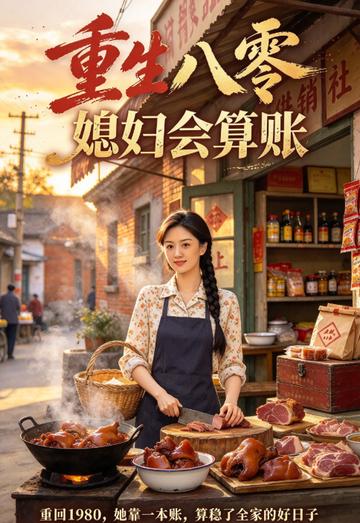
Su He, a supply chain director for a restaurant group, died of overwork at thirty-five. When she opened her eyes, she had become a village girl with the same name in the Yimeng Mountains in 1982. Her fiancé's family had broken off the engagement, then smeared her as "morally corrupt." Her grandmother planned to trade her in marriage to a paralyzed man for a bride price, and she'd just jumped into a well. The first thing Su He said after being pulled out was: "A marriage exchange is fine, but let's settle the accounts first." Sixty-six yuan in bride price, 170 yuan for the private plot, eighty jin of relief grain. She laid out every figure on the brigade office table. Her grandmother was left speechless, and her uncle's hand stopped short of slapping her.
From a permanent stall at the commune market to a shop on the county's main crossroads, from a braised-food workshop to taking over a state-owned food factory, from trading treasury bonds to buying up stalls at the railway station, from negotiating in English at the Canton Fair to building a factory in Shenzhen to export to Hong Kong. Every step of the way, while everyone else was still watching and waiting, she was already taking action.
He Shanhe, a reconnaissance company commander recovering from an injury in the village, witnessed firsthand how this young woman used a shoulder pole to put a stop to the marriage-exchange fiasco, used the 1982 No. 1 Document to turn the tables on the campaign against "capitalist tendencies," and outcalculated the supply-and-marketing cooperative's accountant. He offered connections and a sense of security, but every time he could step in, Su He had already struggled to her feet on her own.
"Eighty cents in costs, 3.2 yuan in profit, eighty-seven yuan to rent the storefront, 100,000 yuan from treasury bonds, ten million from land." The figures in the ledger grew one entry at a time. The worn-out shoes of Nianziyu became the proud brand of the leading braised-food business in northern China. During Deng Xiaoping's southern tour in 1992, she stood at the entrance to her Shenzhen factory and said: "Opportunity always goes to those who do the math first and act first."