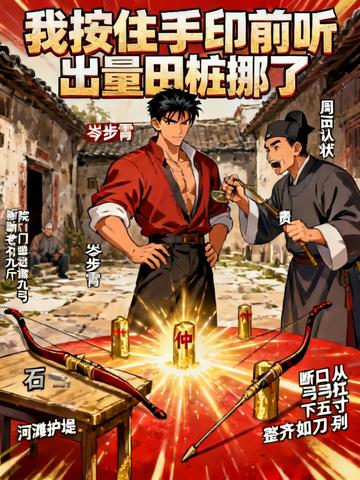
In the courtyard, Zhou Gui, steward of the Zhou family, pressured Cen Buxiao to sign a "shortfall acknowledgment," claiming that the cadastral register listed four hundred bows of prime farmland along the eastern boundary, while the actual survey measured only three hundred and seventy, leaving a shortfall of thirty bows. He demanded that the Cen family's ancestral grave land make up the difference and threatened to have them "stripped of their registration" under the new law. Cen Buxiao saw that the paper listed only the total, not the four boundaries. If they could conceal thirty bows in there, they could just as easily conceal three hundred. He also remembered a scrap of paper in the woodshed that read, "The eastern boundary measures four hundred and seven bows in all," meaning seven bows were missing. He raised his hand to sign, when the old man with the broken bow, Shi Jiujin, stumbled through the courtyard gate and laid two pieces of an old bow on the table. The characters "Shi" and "Zhong" were carved into the bow tips. He said that he had measured the land for Cen Zhong back then, and that all four hundred bows had been measured on the ground. He also pointed out that the Zhou family had shifted the eastern boundary by seven bows over the past twenty-three years. The key was that the stake used as the starting point was a riverbank embankment marker, not a field boundary marker. Zhou Gui sneered, and the courtyard fell silent. But why had the broken bow snapped cleanly five inches below the bow tips, as if someone had chopped it with a knife?