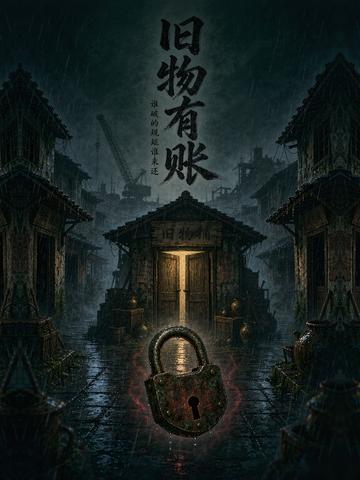
No. 3 Jiucang Lane, the "Three No Collection" junk shop. There are three rules engraved on the wooden sign under the eaves: don't accept people whose origins are unknown, don't accept people who come from bad sources, and don't accept people who come from dishonest people.
It was the third day that the shop was handed over to Shen Yan. It was still raining that day. A man named He Shun burst into the door and slapped an ancestral copper lock on the counter. His voice became hoarse: "Your grandfather took it back, so you have to take it too."
Shen Yan reached for the lock. As soon as his fingertips touched the copper, he saw a layer of something. At first glance he thought it was rust. Look again, those are words. Densely packed small characters spread out from the keyhole to both sides, one line after another, as thin as a needle scratch, like a page torn from an old account book and pasted on the back of the copper sheet. Who owes it, what is owed, and when it is due should be written clearly.
There is an old saying in Linhe's old town: Rules are stronger than the law. Those who break the rules are now prosperous. The debt must be paid sooner or later, with interest.
The trouble is that Shen Yan can only see it and cannot return it for others. What's even more troublesome is that every time he settles a bill for someone else, he has to bear a share. When he has paid ten cents, he will see his account.
When this lock is locked, the creditor column is empty. On He Shun's account, what was written in the column of the debtor was his grandfather's name.
There are ten accounts in total. What Shen Yan didn't know was that the tenth stroke was his own.