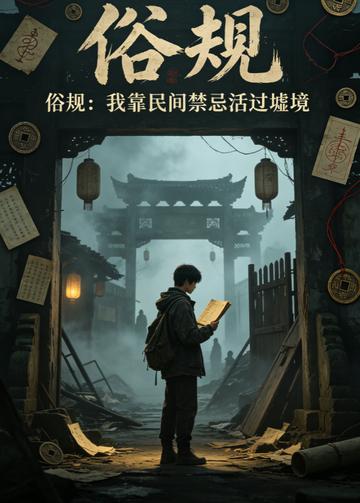
Worldbuilding: Beneath the shadows of the modern city lies an otherworld known as the Ruins, made up of countless independent Chinese-style rule-based horror scenarios. Whenever a traditional lunar-calendar solar term or an ominous day arrives, ordinary people may be pulled into one at random. The scenarios draw on real folk customs: corpse-driving inns in western Hunan, forbidden rituals surrounding the wandering gods of Chaoshan, haunted houses and ghost marriages in the capital, ghost brides in the water towns of Jiangnan, wild shrines of spirit mediums in the Northeast, and divine palanquins making their rounds in southern Fujian. Each scenario has its own rules for survival. Breaking them triggers a different death, and only a rare few can escape alive by uncovering the core taboo. The protagonist, Lin Chen, comes from a fallen family of folk ritual practitioners. Having grown up surrounded by all kinds of taboos and obscure arts, he carries a family heirloom, the Record of a Hundred Taboos, which documents numerous folk methods for warding off evil, avoiding spirits, and breaking out of predicaments. But each use comes at a cost. Among the other players he encounters, some form alliances, some scheme against one another, and others try to challenge the rules with modern logic, only to die horribly. Relying on his ability to divine fortune and misfortune, sense yin energy, and understand the customs surrounding funerals and weddings, Su Cheng gradually uncovers the folk traditions behind the scenarios. He also discovers that the Ruins may be connected to an ancient sacrificial organization whose traditions were lost long ago. Through one desperate struggle for survival after another, he keeps face-slapping the elite players who mock him for his "feudal superstition," eventually becoming the only "rule-abiding person" feared by even the vengeful ghosts in every scenario.