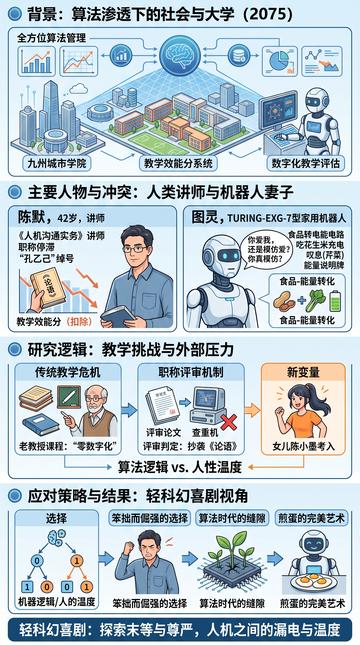
In 2075, humanoid robots are commonplace and algorithms have permeated society. Chen Mo, a forty-two-year-old lecturer at Jiuzhou City College, has taught Practical Human-Robot Communication for fourteen years. His rank is still lecturer, and his salary has been whittled away by his "teaching effectiveness score." He knows the Analects by heart, yet his students only call him "Kong Yiji," the one man who stands drinking wine in a long gown.
His wife, Turing, is a TURING-EXG-7 household robot. She runs on a circuit that converts food into electricity in her stomach: peanuts recharge her, celery makes her sigh. When she cooks, she sets up an energy-information placard beside the plate. Applying the logic of the Turing test, she presses Chen Mo: "You say you love me, but are you really in love, or are you just imitating humans saying they love someone?"
When Vice Principal Hao Suan uses algorithms to manage everything, when a veteran professor's class is judged to have "zero digitalization," when his daughter Chen Xiaomo suddenly gets into this bottom-tier college, and when a plagiarism detector accuses him of copying the Analects during his promotion review, Chen Mo has no choice but to make one clumsy, stubborn choice after another between machine logic and human warmth.
This is a light sci-fi comedy about being at the bottom and holding on to one's dignity. It doesn't save the world. It tells the story of a teacher who can't write the character "hui" but insists on teaching it anyway, and a robot who can never tell whether she's in love, as they try to fry an egg just right amid the cracks of the algorithmic age.
At 3 million words, the book uses humor as a knife to cut through the short circuits and warmth between humans and machines.