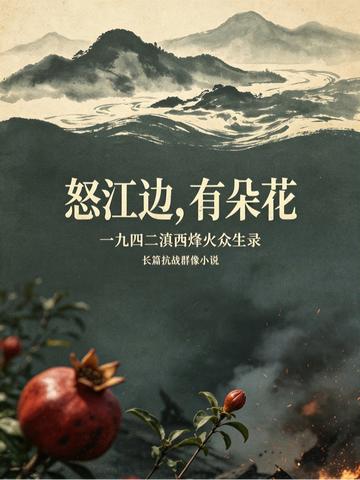
This is a healing novel set against the backdrop of the Anti-Japanese War in western Yunnan in 1942. In search of her lost father, female college student Lin Qingyan narrowly escaped death by the Nujiang River and was rescued by people at the Sichuan Legion's shelter. The story takes her as the axis, and gradually unfolds a picture of human tenderness in the war: the rough but attentive Milong, the mean but kind-hearted Meng Fangli, the kind-hearted Veterinary Hao, the steady Sister Shangguan... Everyone is protecting this new "family" in their own way. She worked as an English translator at the shelter, and developed a tacit understanding and affection during their daily interactions with the deputy leader Long Wenwen. The silent care of Yu Xiaoqing and Zhang Lixian added a complicated footnote to her fate. In the end, she found her father, and also found a new emotional sustenance during the war - the patch of henna and sunflowers outside the wall became everyone's spiritual destination.
Instead of writing about the grand war filled with bullets and bullets, I only write about how people ate, chatted, planted flowers, and waited in the cracks of gunpowder smoke, and re-picked up the roots of life in the midst of displacement. Delicate and warm, using flowers as a metaphor, it tells how ordinary people help each other in troubled times and plant hope in each other's hearts. As the article says: "People are like this. When they are forced to a dead end, they can learn anything." This is a group portrait about finding, finding a home, and the power of softness. In the cruel world, guarding an everlasting lamp, a flower blooming under the wall.