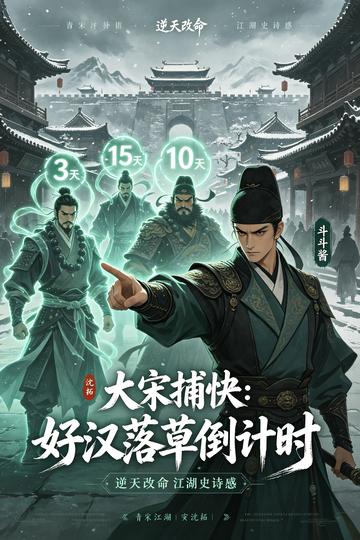
Shen Tuo, a catcher from the Song Dynasty, traveled to Bianjing. He originally just wanted to fish and live a leisurely life, but found that he could see the "countdown of fallen grass" above the heads of the heroes. Wu Song's blood spattered Yuanyang Tower three days later, Lin Chong's Fengxue Mountain Temple fifteen days later, Lu Zhishen killed Zhen Guanxi with three punches ten days later - if he had stood by and watched, Liangshan One Hundred and Eight would be destined to be reunited, and the Northern Song Dynasty would be destroyed by the Jingkang Incident.
He chose to change his fate against fate.
From the streets of Bianjing to the wind and snow at the border, from the intrigues of the court to the thousands of troops, he stopped the heroes who were forced to die one after another, brought down Gao Qiu, and defeated Cai Jing, but found that every step he took was in the chess game of destiny. System, catastrophe, amnesia, hidden stakes of Liao Kingdom, cavalry of Jin Kingdom - destiny is like a knife, hanging above the head. But behind him stood Wu Song's sword, Lin Chong's spear, Lu Zhishen's Zen staff, and one hundred and eight lives that he had pulled back from the dead end.
When he finally allowed Wu Song's countdown to return to zero, Song Jiang's anti-poetry to be erased, and Fang La's uprising to be rewritten, he finally understood: the price of changing one's fate against fate is not death, but living as a hero's sword. If destiny suppresses it, then split it open; if the country is to be shattered, then use fists and knives to create another one.
This is a river and lake epic in which a time traveler stirred up the storms of the Northern Song Dynasty and stopped the torrent of destiny with his flesh and blood.