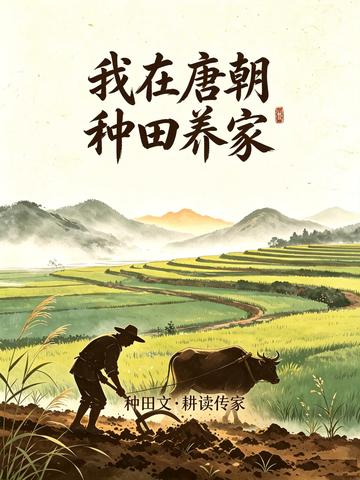
Li An, a researcher at the Academy of Agricultural Sciences, died in the line of duty.
When he opened his eyes again, it was already the Tang Dynasty. He had become an orphan in a cold kiln with a bare family. His parents had recently died, his property had been occupied, and he had only a skinny old scalper to accompany him.
There is leaking thatch above the head, and beside him is his distant cousin who is looking at him eagerly. The whole village is waiting to see this "foolish" boy starve to death in the spring famine.
Fortunately, with him came a bank of agricultural knowledge.
He selected improved seeds from a handful of moldy corn and used the "three-layer method" to create the "black gold" compost that the villagers avoided.
He lifted up the heavy straight-shaft plow and drew the first sketch of the curved-shaft plow; he brewed mountain wine and distilled "Heian Shao" which was stronger than the burning knife.
In this barren village, he plowed a road from abject poverty to wealth with both hands.
When he repaired the leaky roof and allowed heavy ears of millet to grow on the wasteland, the eyes of the villagers changed from contempt to awe.
When he built a waterwheel to irrigate thousands of acres of farmland and led the whole village to escape the locust plague and weather the war, even the county magistrate wrote in his own hand that he was "a model for persuading farmers."
He just wants to guard this land, be a farmer with a family and land, protect his wife and children, and live a solid life where his wife and children are on the hot bed.
But he didn't expect that the rice seeds he improved would be heard by people all over the world, and the "Book of Peaceful Farming" he wrote would be passed down through the ages.
Many years later, when the rebels' iron hooves trampled through the mountains and rivers, the only smoke rising from the Guanzhong land came from the "Loyalty Fort" he built with his own hands.
"I just wanted to farm, but I accidentally planted a prosperous world."