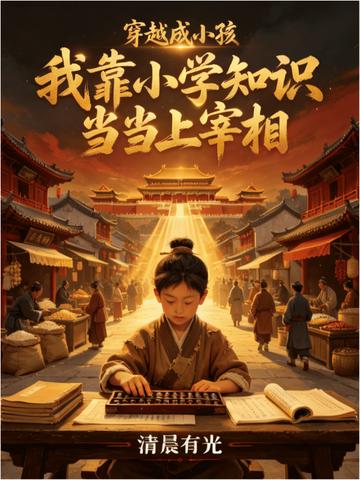
Shen Zhibai, a top student in sixth grade in the modern era, woke up to find himself the seven-year-old youngest son of a dirt-poor farming family in the Great Liang dynasty. Their house was bare, and his uncle had come to their door demanding payment on a bogus debt. The whole village was waiting to laugh at the “little brat.”
But with a quick flick of the abacus, he neatly untangled accounts that had left the bookkeeper scratching his head. One word, “buoyancy,” solved a difficult river-engineering problem. With a bar of soap and a spoonful of sugar, he scraped together his first fortune.
People scoffed: What could a seven-year-old possibly know?
They had no idea that Shen Zhibai carried an entire elementary-school curriculum in his head: mental arithmetic, basic science, introductory physics and chemistry, and a store of poems. To the Great Liang dynasty, where mathematics was neglected and common knowledge remained obscure, these ordinary facts of modern life were miraculous breakthroughs from a higher dimension.
From bookkeeper at a county grain shop, to a child prodigy celebrated throughout the county, to passing the imperial exams and entering government, then reforming the court: he climbed, one careful step at a time, to heights others could not reach in a lifetime.
Yet the higher he climbed, the more clearly he understood: elementary-school knowledge alone would never be enough to make him chancellor. Being good at solving problems was far from sufficient...
The author is an accountant and knows what problems can be solved with financial knowledge.