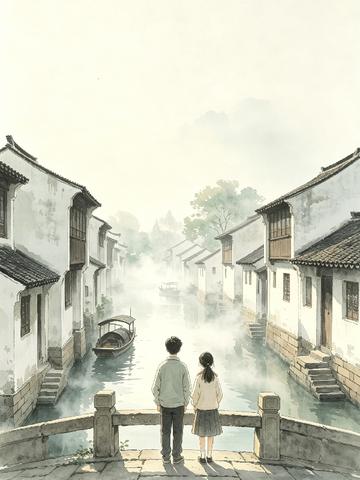
A country girl who was reluctant to wear new shoes even on rainy days came to a sinking Jiangnan town carrying a woven bag. Zhang Hui had nothing - no skills, no acquaintances, no escape route, only a pair of hands and a clumsy patience that refused to accept fate.
There is a copper shop at the end of the town, and the young craftsman in the shop, Zhou Ningyuan, is the last person in the town who still makes copper by hand. The walls full of copper pots and basins glowed warmly in the sunlight, but it had been a long time since he had made anything specifically for anyone. All that was left in his life was a cycle of hammering - the hammer fell on the copper surface, one hammer after another, without the need to speak to anyone, and no one to speak to him.
Zhang Hui settled in a bamboo weaving workshop in the town and passed by the shop every morning and evening. She didn't understand copper, and she didn't know what a person could knock out in a shop all day long. But as she passed by, she would slow down and take a look inside. Can't tell why.
Later she saved him from a fever. Later he gave her a copper basin.
There are two words chiselled on the bottom of the pelvis. Her name. And his name, each took half and engraved them side by side.
This is a story about "slowness" - slowly learning a craft, slowly getting closer to a person, and slowly letting life grow into its own shape from scratch. Beating copper and weaving bamboo are both manual tasks. The bamboo strips have several hardnesses ranging from green to yellow. It takes tens of thousands of hammer drops to change the copper surface from rough to smooth. The same is true between people: there are no shortcuts, only when the time is up and enough knocking can the fit be perfect.
The scenery and people in a small town in Jiangnan in the 1990s, two young people used their double