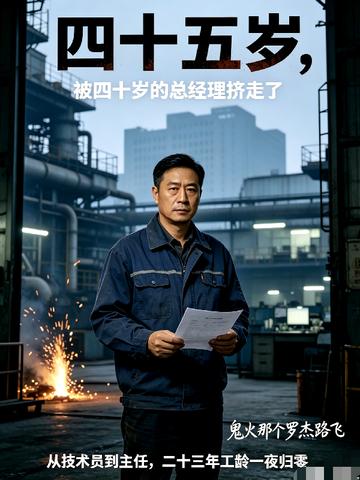
A third-level subsidiary of a manufacturing central enterprise has grown from a start-up team of more than 100 people to a giant with 4,000 people in 23 years.
Chen Mo grew up watching it.
After graduating from a prestigious university, I entered the factory, stayed in the workshop, stayed up all night, and solved countless technical deadlocks, all the way to the position of head of the fourth-level company department.
He thought that relying on his ability to earn a living would help him survive anywhere.
Until the 40-year-old airborne general manager took office.
Operations rely on stock, decision-making revolves around contradictions, and management relies entirely on meeting and following procedures. They are a sounding board to others and a soft persimmon to others. Only old employees are the most ruthless.
At the age of forty-five, his promotion path was completely blocked, and even his position was in jeopardy.
Twenty-three years of youth cannot buy justice.
Some people advised him to work as a foreigner and retire, while others advised him to bow his head and submit.
Chen Mo chose the third path.
Counterattack decently and leave the field cleanly.
The iron rice bowl is great, but he doesn't want to spend the rest of his life soaking in a pool of stagnant water.
Reader comments
The protagonist of this book does not rely on golden fingers or write about adventures, but only relies on "reality" to describe the ups and downs of the grassroots technical backbone of central enterprises for more than 20 years. The protagonist, Yao Lizhi, graduated from a prestigious school and worked in a small factory with 100 people to a large enterprise with 4,000 people. He has excellent skills, but he is squeezed out by his connections step by step. The credit for the work was taken away, the blame was taken first, the promotion was failed, and even a certificate of merit became a luxury. Every "grievance" in the book is real: a report was returned, a signature was replaced, and a deputy director suddenly landed. No hyperbole, no accusation, just the smell of engine oil in the workshop and the undercurrent on the conference table. Yao Lizhi's counterattack was as always - following procedures, obtaining data, and being logical, ruthless and clean. The most touching thing about the novel is that he is being smoothed away by the system while still clinging to the bottom line of a technical man. It's so realistic that it makes people silent, and it's so exciting that it makes people want to commit crimes. This is not a cool article, it is the epitome of millions of people who do hard work.
The protagonist of this book does not rely on golden fingers or write about adventures, but only relies on "reality" to describe the ups and downs of the grassroots technical backbone of central enterprises for more than 20 years. The protagonist, Yao Lizhi, graduated from a prestigious school and worked in a small factory with 100 people to a large enterprise with 4,000 people. He has excellent skills, but he is squeezed out by his connections step by step. The credit for the work was taken away, the blame was taken first, the promotion was failed, and even a certificate of merit became a luxury. Every "grievance" in the book is real: a report was returned, a signature was replaced, and a deputy director suddenly landed. No hyperbole, no accusation, just the smell of engine oil in the workshop and the undercurrent on the conference table. Yao Lizhi's counterattack was as always - following procedures, obtaining data, and being logical, ruthless and clean. The most touching thing about the novel is that he is being smoothed away by the system while still clinging to the bottom line of a technical man. It's so realistic that it makes people silent, and it's so exciting that it makes people want to commit crimes. This is not a cool article, it is the epitome of millions of people who do hard work.
Good book, I recommend everyone to read it