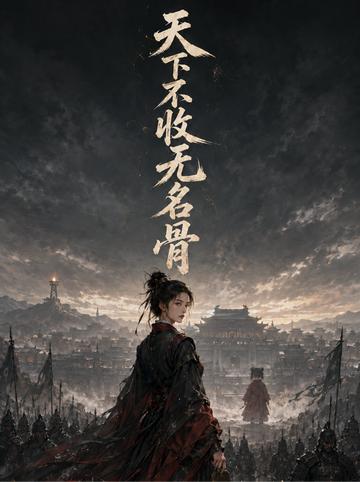
The World Will Not Accept Nameless Bones
天下不收无名骨
- Status
- Ongoing
- Length
- 148k Words
- Genre
- Mystery
- Subgenre
- Female-Channel Mystery
- Audience
- Female
- Updated
- 17d ago
- Source
- Fanqie
Stats
13Reads
54Chapters
4Listens
16Reads · all time
Tags
Synopsis
Reader comments
In booklists 4
Ancient Chinese Novels with a Score of 9.8 or Above, Any Subject Matter
Anyone who clicks in will not be disappointed. Leave your book list and let us all benefit from it.
582.9MViews256Books2dUpdated
Shuhuang Square.
In the bookstore square, those who have good books can come in and share them. A group of bookstores are waiting to feed them.
662.5kViews423Books15hUpdated
Entrance to Shuhuang Square
Shuhuang Plaza is so hard to find! If you have any favorite books, bring them all!
156.1kViews432Books2dUpdated
A Novel with a High Score of 9.9! ! ! !
A higher score than next door's Li Jin Qian Fan and Qi Tian Xiao Sheng!
0Views592Books1dUpdated
When I first wrote "The Nameless Bones", I thought I was writing a very simple story. A child's family was ruined and he was taken away by someone. She survived, grew up, and then looked back to find the truth of what happened back then. There are many such stories. If she follows this path, she should finally regain her real name, find out her father's injustice, make those who should pay the price pay the price, and then regain her original position. But as I write it, I increasingly don't want to end it like this. Because of the people Gu Heng met along the way, the matter of "restoring his real name" became more and more suspicious. Some people have died, but their names are still receiving food. Some people are alive, but they are listed as dead on the official list. Some people borrowed the name of a dead person to enter the city, some borrowed someone else's father to get a bowl of medicine, and some people did many things in their life, and in the end only the word "unnamed" was left on the corpse book. Therefore, these three words of Lu Mingzhao are no longer just an answer waiting for her to get back, but gradually become an exploration of power and who can hold power throughout the entire narrative process. She had to start asking: If a name can be written on or crossed out by the government, then who does the name belong to? Is the proof of a person's life a household address, military registration, corpse register, or someone who really knew him? If all the files are written incorrectly, does a person really never exist? But then the problem became bigger and bigger. It has changed from the name of a child to the name of a group of people; from a corpse book, it has become military registration, household registers, old orders, private seals and old volumes that no one is willing to reopen. I also gradually discovered that what I really wanted to write about was not discovering and finding the truth of that year. Finding the truth is easier than I initially thought. The hard part is what to do after you find it. Lu Chongyue did something wrong. In order to protect her daughter, Zhao Lingyi also hurt others. Han Che had been loyal and obeyed an order that he should no longer obey. Shang Yue believed that he was protecting some people, so he killed others. Even many systems were not malicious when they were first created. What really makes these things dangerous is often not that a bad person suddenly comes one day, but that they are dealt with in this way one after another, making an exception this time, and then make up for it after the incident has passed. Looking back many years later, no one can remember when the first step was taken, but it was like a butterfly effect that brought about great changes. Many times in this world, there are no absolute boundaries between right and wrong. So I didn't write about an absolutely clean person in this book, and I didn't want Gu Heng to get the sentence "Your father is innocent" in the end. Because that's too easy. What she really needs to accept is another thing: The false accusation against the father should be removed. The things that my father really did should also stay. Her mother had protected her. The things my mother forged should also be kept. Like someone, understand someone, or even forgive someone, does not mean that you have to modify the record for him. This is where Gu Heng really grew up. As a child, she could only accept who she was told she was. Later, she started deciding on her own names. Later, she finally had the ability to face the names left by others, but she was not in a hurry to wipe them clean for anyone. She began to have the power of choice. So if I have to say what this book is about, I would probably say now: it is about a child who was once described as a "dead person" by the world. When he grew up, he began to ask... Who has the right to decide what a person is called. Who gets to decide what should stay. And, When everyone is accustomed to covering a person's life with "anonymous", is there anyone who is willing to bend down again and ask: Who is he? This is probably why the title of the book ultimately stuck. Of course, it may not be as eye-catching as many fast-food novels, but this book itself is carefully crafted, and it is a work that requires patience and careful reading. In an era where traffic is paramount, I still feel that these works are needed. I have to admit that my personal experience and energy are limited, and many details may not be polished perfectly. But like Gu Heng, I hope that I can grow up with her and become an outstanding person. The world is huge. It can accommodate the imperial city, it can accommodate thousands of armies, it can accommodate the merits and demerits of one generation after another. If in the end there is no room for even the name of a corpse, then the world is probably not as big as I imagined.
Great, it's the ancient strategy I like