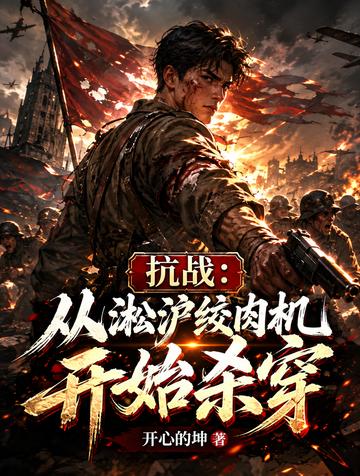
During the Battle of Shanghai, a Nationalist Army division was scattered. Only six men remained along the entire defensive line.
New platoon leader Lin Yaozu opened his eyes and discovered he had gained something.
An elevation map spread across his mind, with the coordinates of Japanese grenade dischargers accurate to the meter.
He called out a set of firing parameters no one could understand.
The shell sailed over two earthen ridges and hit an ammunition box beyond their line of sight.
The ammunition detonated in a chain reaction.
The five veterans looked at him as if he were the living King of Hell.
But no one asked how he had done it.
On the battlefield, if it could kill the Japanese, it was a useful skill.
Oddly, he got a nosebleed every time a simulation ended.
Even stranger, the collar insignia and officer's swords taken from slain officers were the fuel that powered it all.
A sergeant major's collar insignia: one minute.
A junior officer's saber: ten minutes.
What about a senior officer's sword?
The System's answer: a battle-scale simulation.
He began leading his men on decapitation missions.
Not for military honors, but to see farther and calculate more accurately.
Six survivors became ten. The ten of them acquired artillery and a vehicle.
On a captured Japanese route map, a string of artillery symbols marked the northern freight yard.
Lin Yaozu drew his second lieutenant's saber...
Would a ten-minute simulation be enough to destroy an entire artillery convoy on the move?
The words are too confidential and have no meaning.