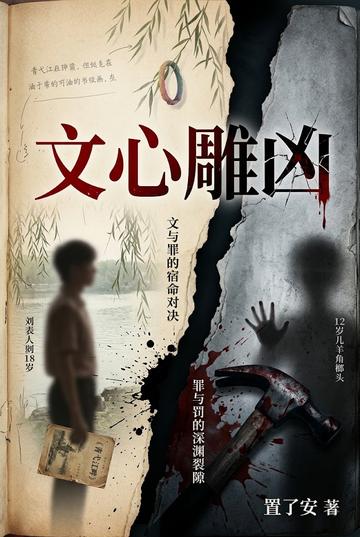
"Wen Xin Diao Ji" takes the double life of the writer and murderer Liu Biao as the axis to open up the bottomless gap between crime and punishment, talent and virtue. When he was eighteen years old, he squatted by the Qingyi River, holding the mimeographed third issue of "Qingyi River", thinking that the words could take him far away. Shen Xiu was his earliest reader. He used a pencil tip to annotate the corners of his manuscript paper, and lent him five yuan to publish an article in the provincial capital. He gave him a roll of colored hairband in return. But literature failed to send him out of his hometown - rejection letters came like a snowflake, his work failed, and his lover married someone else. In the late autumn of 1995, he and his younger brother Wang Ming walked into the Minji Hotel in Zhili Town, Zhejiang Province. They raised a claw hammer and smashed the skulls of four strangers for a sum of non-existent cash. The youngest victim was a twelve-year-old child. In the next twenty-two years, Liu Biao became a successful writer, covering that bloody night layer by layer with words, but the dull sound of the hammer always seeped out from between the words. Until the backlog of cases was restarted, the female detective broke through all his disguises by saying, "When you wrote about Wu Song's murder, were you thinking about that night?" On the eve of his execution, Shen Xiu said on the phone: "Liu Biao, I don't hate you, I just feel sorry for you." The work coldly asks: When a villain uses talent to package crimes, are those words the fruit of art or the evidence of the crime itself? The Qingyi River is still flowing, and the faded headband is still hanging on the willow branches, like a sentence that will never be finished.