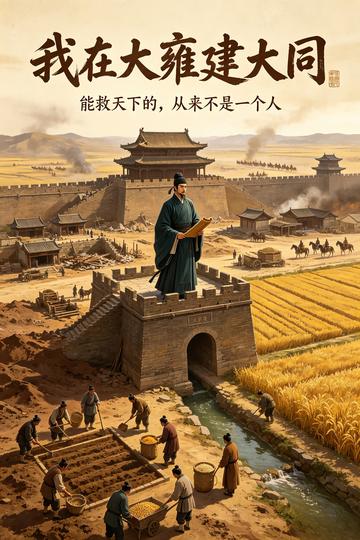
Lin Mo dies on his way to the countryside to help alleviate poverty. When he opens his eyes again, he has become the governor of Guyu Commandery, the poorest border region in the northern reaches of the Great Yong Dynasty.
Before him are empty granaries, fewer than two hundred battered soldiers, starving refugees whose seven-tenths of the irrigated farmland has been seized by the powerful Zhao clan, and Di-Rong raiders who sweep south every year. The System in his mind, “Great Harmony,” lights up with a territory panel, quest chains, and a blueprint library, but it only provides plans, not results. If he wants to survive, he'll have to organize the people himself.
He doesn't cheat his way to victory by slaughtering a city. Instead, he applies modern methods, painstakingly measuring and redistributing the land, setting up mutual-aid cooperatives, opening public granaries and schools, and establishing collective workshops. The powerful laugh that his “barbarian methods” will ruin the land. He weighs the harvest in front of everyone, doubling the yield per acre and proving them wrong. Confucian scholars condemn him for violating tradition. He uses his account books to show exactly who is stealing the people's land. When the Di-Rong invade, he relies on early warnings and militia ambushes to drive them off without a single casualty.
The talented people he recruits aren't divine soldiers who simply appear out of nowhere. They are real people who must make the arduous journey from a hundred li away, face dangers along the way, and, once they arrive, be won over with land and dignity.
From a border city on the brink of starvation to a model of “Great Harmony” in a time of chaos, where everyone has food to eat and books to read, and the elderly are cared for, Lin Mo sets out to prove that salvation has never come from one person, but from people working together as an organized whole.
(Tags: transmigration · System · farming and infrastructure · institutional development · no female lead)