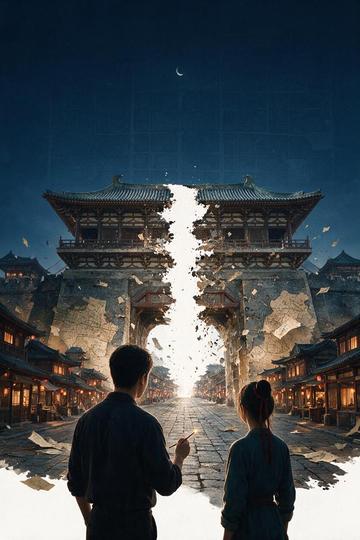
Shen Yan, a young restorer at the National Library, received an unknown incomplete picture of Chang'an from the Tang Dynasty. In the picture, Zhuque Street is still there, but the Mingde Gate has been neatly cut off; my father, who has been missing for ten years, actually left a warning on the mezzanine: Do not mend the city gate.
When Shen Yan made his first stroke, he was involved in Chang'an on the night of the Yuan Dynasty. The city gate will disappear at midnight, and along with it will be erased the memories of the twelve squares and one hundred thousand people in the south of the city.
He has no system and no martial arts skills. He can only rely on restoration skills, records in ancient books and judgment of the urban texture. Distinguish paper, recognize ink, check waterways, and repair squares. One stroke saves a street, and one picture defends a city.
From Chang'an to Bianjing, from Jiankang to Luoyang, when ancient cities reappeared in the residual pictures, Shen Yan finally saw the question that spanned thousands of years: If forgetting can save living people from pain, do we still need to remember the truth?