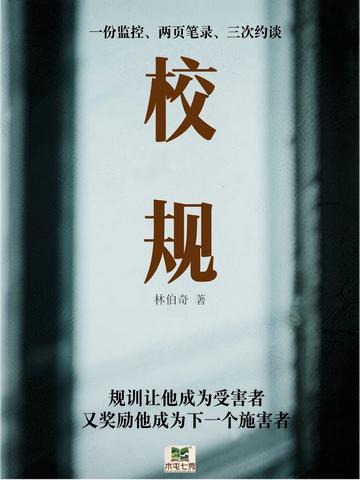
[Post-00s Perspective + Emerging Writers + Educational Reflections + Ignorant Youth + Campus Romance] One surveillance, two pages of transcripts, and three interviews. Discipline makes him the victim and rewards him to become the next perpetrator.
Sixteen-year-old Li Kai was originally just an ordinary student on campus with "good or bad" grades, soccer skills, and life. After falling in love with Chen Jia, the two had a clumsy but real youth in the gaps between comic exhibitions, cinemas, arcades and evening self-study. However, the new head teacher Lan Zhicheng enveloped the class with an almost surveillance-style disciplinary management, treating the intimate relationships between students as dangers that must be investigated, recorded and punished.
A brief moment of solitude was characterized as an "inappropriate interaction." Parents, the Education Office, and the school rules immediately intervened. The "just" in the hands of the two teenagers was ultimately no match for monitoring, records, and prepared decisions.
During the suspension period, Li Kai accidentally traced Lan Zhicheng's boyhood: this cold teacher, who was ridiculed by students as an "old virgin", was once a serious, shy boy who believed in love, but was surrounded, misunderstood and institutionally punished because of a public confession. After that, instead of getting rid of the hurt, he learned the technique of turning feelings into "problems" and people into "materials", and copied the old trauma to the next generation.
The novel uses black humor and a grim campus narrative to describe how youthful emotions are distorted by discipline, shame, and group malice. It neither excuses the perpetrator nor simply attributes the tragedy to "a bad teacher": what is truly terrible is how an environment first creates a victim and then rewards him for learning to use correct words such as "education", "boundary" and "responsibility" to continue hurting others.
Reader comments
Simple and straightforward text outlines the daily life of young people, without any dramatic plot. The protagonist's ordinary life is like a bowl of inconspicuous fried noodles. It seems tasteless, but it touches the youthful background of countless people. It is real and has a touch of sadness.
The teenagers in the book are trapped in this system of rules. Some choose to obey and compromise and suppress themselves within the rules; some rise up to resist, but have to pay a heavy price. The author truly depicts the confusion, impulsiveness and helplessness of adolescence, and reveals the conflicts in the campus environment. It not only exaggerates the pain of youth, but also uses the campus as a microcosm to question the meaning of rules: rules should restrict behavior rather than destroy human nature. When the system is divorced from human nature, the so-called order loses its original value.
"School Rules" cuts into campus reality from the perspective of post-00s teenagers. Surveillance, transcripts, and three interviews form the core clues of the story. School rules are supposed to be the yardstick for maintaining order, but rigid discipline pushes the victims step by step to the position of the perpetrators. The story is intertwined with the emotions of ignorant teenagers, confronts the collision of old and new educational concepts, and tears apart the alienation of people by the system in the campus environment. The length is concise, the reflection is sharp, and it makes people think deeply about the true meaning of education.
The novel unfolds from the perspective of young Li Kai, and the language is straightforward and vivid. The sentence "good or bad" expresses the confusion of ordinary youth and tells the plain and true thoughts of young people. It is close to campus life and writes about the bewildered state of many ordinary people in adolescence.
This book describes the ups and downs of life in the village from the perspective of a diary. Cadres go deep into the masses to solve problems for villagers. The writing is plain and sincere, full of local warmth, making one feel the perseverance of countless people behind rural revitalization.
This book takes school rules as its theme and explains the meaning of rules and freedom. There is no circle without rules. School rules govern words and deeds and cultivate character. The content is easy to understand and close to campus life. It taught me to respect rules, be civilized and self-disciplined, and to be a qualified middle school student.
An 80,000-word campus reality novel that reveals the other side of campus rules from the perspective of a post-2000 generation. Under surveillance, records and interviews, discipline can create victims and also give birth to new perpetrators. The story of youth completes a sharp reflection on the educational environment.
The sorrow of the times!
Those born in the 1980s are aging before they get old!
Being pushed to the ground and rubbed by a child born in 2000!
Based on the reality of teenagers' campus, it uses school rules and regulations to reflect on the educational dilemma. There is a sharp torture of human nature hidden under the plain narrative.
What do emerging writers born in the 2000s think of the educational philosophy of the old-school post-80s dean? Please read this book!
The people born in the 1980s are now Lao Deng!
Calmly written about campus reality, it faces the paradox of campus discipline and explores the harm and alienation of young people under the system.

Simple and straightforward text outlines the daily life of young people, without any dramatic plot. The protagonist's ordinary life is like a bowl of inconspicuous fried noodles. It seems tasteless, but it touches the youthful background of countless people. It is real and has a touch of sadness.
The teenagers in the book are trapped in this system of rules. Some choose to obey and compromise and suppress themselves within the rules; some rise up to resist, but have to pay a heavy price. The author truly depicts the confusion, impulsiveness and helplessness of adolescence, and reveals the conflicts in the campus environment. It not only exaggerates the pain of youth, but also uses the campus as a microcosm to question the meaning of rules: rules should restrict behavior rather than destroy human nature. When the system is divorced from human nature, the so-called order loses its original value.
"School Rules" cuts into campus reality from the perspective of post-00s teenagers. Surveillance, transcripts, and three interviews form the core clues of the story. School rules are supposed to be the yardstick for maintaining order, but rigid discipline pushes the victims step by step to the position of the perpetrators. The story is intertwined with the emotions of ignorant teenagers, confronts the collision of old and new educational concepts, and tears apart the alienation of people by the system in the campus environment. The length is concise, the reflection is sharp, and it makes people think deeply about the true meaning of education.
The novel unfolds from the perspective of young Li Kai, and the language is straightforward and vivid. The sentence "good or bad" expresses the confusion of ordinary youth and tells the plain and true thoughts of young people. It is close to campus life and writes about the bewildered state of many ordinary people in adolescence.
This book describes the ups and downs of life in the village from the perspective of a diary. Cadres go deep into the masses to solve problems for villagers. The writing is plain and sincere, full of local warmth, making one feel the perseverance of countless people behind rural revitalization.
This book takes school rules as its theme and explains the meaning of rules and freedom. There is no circle without rules. School rules govern words and deeds and cultivate character. The content is easy to understand and close to campus life. It taught me to respect rules, be civilized and self-disciplined, and to be a qualified middle school student.
An 80,000-word campus reality novel that reveals the other side of campus rules from the perspective of a post-2000 generation. Under surveillance, records and interviews, discipline can create victims and also give birth to new perpetrators. The story of youth completes a sharp reflection on the educational environment.
The sorrow of the times! Those born in the 1980s are aging before they get old! Being pushed to the ground and rubbed by a child born in 2000!
Based on the reality of teenagers' campus, it uses school rules and regulations to reflect on the educational dilemma. There is a sharp torture of human nature hidden under the plain narrative.
What do emerging writers born in the 2000s think of the educational philosophy of the old-school post-80s dean? Please read this book! The people born in the 1980s are now Lao Deng!
Calmly written about campus reality, it faces the paradox of campus discipline and explores the harm and alienation of young people under the system.