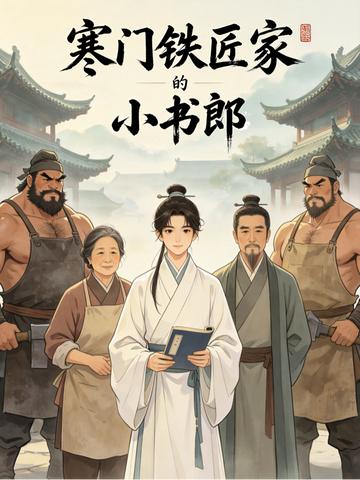
The third son of the Zhou family is reborn as the sickly youngest child of a poor blacksmith.
Everyone in the family can swing a hammer, but he’s out of breath after just one swing. His father thinks he’s useless, his mother worries but won’t admit it, and his two older brothers take on all the hard work. In the end, the family grits its teeth and decides: if he can’t forge iron, then he’ll study!
But studying costs money.
The third son squats beside the furnace and watches the fire. Starting with a worn-out plowshare, he helps his family improve farm tools, repair iron pots, make axles, and calculate material costs, somehow bringing their rundown smithy back to life.
People laugh at the blacksmith’s son for dreaming of passing the imperial exams.
But when the results come in for the county, prefectural, academy, and provincial exams, everyone discovers that this frail young man’s essays aren’t empty talk. Every sentence comes from the everyday concerns of ordinary people.
Later, he joins the Ministry of Works, upgrades military equipment, and promotes technical education.
The third son, who once couldn’t even swing a hammer, eventually brings the crafts of every trade in the realm into the imperial court.

How can I put it, the more I watch it, the more I feel that the protagonist doesn't look like a time traveler. Memorizing the Three-Character Sutra is like going through ninety-nine and eighty-one difficulties. Yes, it is really hopelessly stupid.