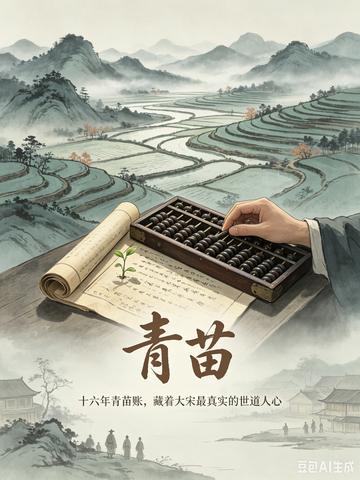
In the second year of Xining, Wang Anshi implemented the Green Crop Law, which replaced the double interest rate of private loans with two official loans, which was originally intended to benefit the people and promote good governance.
The nineteen-year-old county government official Si Lu Zhengze watched with his own eyes as the new law was posted on the field ridge from Bangyu Pavilion.
He once thought that farmers could finally escape the exploitation of loan sharks, but he did not expect:
Under the pressure of taking exams, voluntarily applying for a loan became a per-household payment;
Under the joint guarantee system, if one household evades its debt, four households will be involved;
In a year of severe drought, official debts can only be extended but not waived. The annexers take the opportunity to acquire land at low prices...
Farmers who had devoted their lives to selling their ancestral land became refugees. Li Zheng, a conscientious farmer, sold all his property to fill holes for his neighbors. Large local households took advantage of the loopholes in the system and cut thousands of acres of fertile land into pieces, hiding it in the list of low-income households to avoid taxes and lend money.
In the blink of an eye, sixteen years passed, and Lu Zhengze rose from a young clerk to a housekeeper, and the abacus turned the beads one after another.
In the court, the old and new parties quarreled one after another. New laws were implemented and then abolished, and after they were abolished, they were implemented again.
In the old files in Jiageku, he secretly wrote down one hundred and four names that have been crushed by the times.
This private book is called "Green Miao".
There are no emperors or generals in the book, no parties fighting for power, only the most real life and death on the fields of the Song Dynasty.