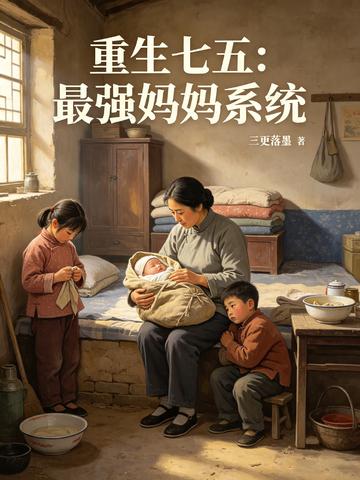
This book tells the story of a woman who has had all her edges worn away by the roughness of life. After regaining a chance, she raised her three children in the simplest way - not by relying on the golden finger of foresight to crush the times, but by finally seeing the true appearance of the children through a pair of eyes. Zhang Guilan's previous life became a symbol: a rural mother who died of exhaustion on the field. Before she died, her three children stood beside her bed. She found that she didn't understand any of them. In this life, she woke up from the delivery room, with her newborn third child lying next to her, the seven-year-old Da Ya huddled in the corner and did not dare to cry, and the four-year-old Tiedan still had a low fever. What the system gave her was not money, but small reminders: "Da Ya hasn't had a full meal in two days" and "Tiedan's cotton-padded jacket has air leakage under her arms." All the capital she owns is a body engraved into the bones by the memory of labor in her previous life, and a heart swollen with guilt. The temperature of the charcoal fire in the stove in late autumn - outside is the chilling wind of 1975, and inside the house is a woman burning herself into warmth. Warmth is not because everything goes smoothly, but because every choice carries the pain of the previous life as a weight. The cold part is the harshness of the era itself: the work points are not enough to deduct the rations, the men do not send any money for three months in the mines, and the women sit in the corners during the production team meetings. But Zhang Guilan's every move is to fight against this coldness - quietly grabbing an extra handful of rice, spreading the cotton from her cotton-padded jacket to Da Ya's cotton trousers, walking thirty miles to the hospital in the cold winter to ask for antipyretics - not heroism, but a mother who finally has the opportunity to sew back the debts of her previous life, stitch by stitch.