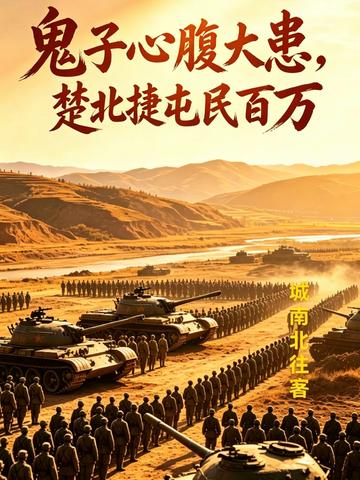
Parallel time and space, China, in 1938, northwest Shanxi was raging with war. The Japanese army surrounded and suppressed the independent regiment, and Zhao Yunlong's army was on the verge of being wiped out.
Chu Beijie, the leader of the 338th Regiment, ignored the strict orders of his superiors to hold troops still and resolutely ordered the mountain artillery battalion to open fire across the board, tearing open the Japanese encirclement and rescuing Zhao Yunlong.
The guilt of disobeying military orders was heavy on him, and official strife and exclusion from all parties followed one after another. The frustrated Chu Beijie decided to leave the Hetao wilderness with more than a dozen soldiers who followed him from his hometown.
When he was in despair, the [Falanqian Defense Line Construction System] was accidentally activated, unlocking a full set of technologies for fortress fortification, military smelting, and military training. Sitting on thousands of miles of fertile soil, Chu Beijie used the Maginot-style multi-layered defense system as the foundation, dug deep trenches, built permanent fortresses, and produced his own guns and tanks. He reclaimed wasteland to feed the soldiers and civilians while supporting various anti-Japanese armed forces.
Steel barriers were built at Wubulangkou, and a series of fortresses were built along the Yellow River. They trained and expanded their troops, produced their own ordnance, eliminated bandits, and resisted the Japanese invaders' westward advance. In the past, the down-and-out commander of the regiment, who had fled the Hetao alone, firmly guarded the gate of Suixi with layers of solid defense lines. The troops under his command grew stronger and stronger, becoming a serious problem that the Japanese army feared day and night.
The mountains and rivers are broken, and the Japanese invaders are rampant; at Hetao Fortress, the Chu commander rules the roost!