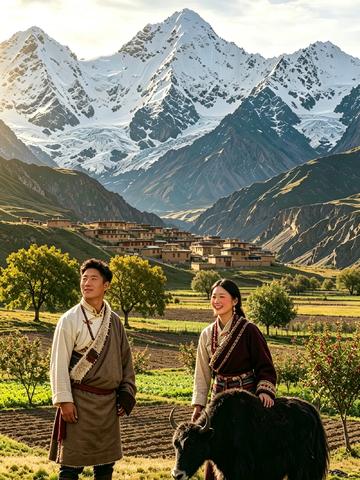
This is a family epic set on the Western Sichuan Plateau. The story begins in the thirty-sixth year of Qianlong's reign (1771) when the Qing government implemented the "return to native land" policy in the Quqin Valley. Suo Langkang, the general of the Green Camp, was sent to Tibet by the imperial government. At the Mani Dzong Fort, he met the chieftain's niece Tenzin Ongmu, who had a wandering background - a girl whose mother was a Han and her father was a Tibetan, and neither of them could get along with each other. Two "nowhere people" got married and took an old soldier deep into the remote Miya Valley, between the snowy mountains and rapids. Starting from a shack and a mud house, they opened up wasteland, cultivated fields, took root, and built a compound with the blood and sweat of three generations.
In the second generation, the eldest son Tashi was brave and resolute, inherited the family business, and married the daughter of the chieftain of Mani Zongba, Zerenamu; the second son Yunden was gentle and shrewd, and returned from Luguan with his Han wife Yunduo. The brothers, one martial and one civilized, supported the caravans and warehouses side by side, uniting the scattered villages in the valley into a self-contained family that communicated with both Han and Han people. The story ranges from the suppression of bandits in Yingzui Mountain to the aroma of fried bacon with peppercorns in the kitchen. The story unfolds among the pots and pans and the caravans of firecrackers - the enthusiasm of highland barley wine, the longing under the walnut tree, and the Mid-Autumn Festival reunion where Chinese-style braised pork and Fan-style blood sausage sit at the same table.
The novel uses a soothing and affectionate tone to describe how a family grew from scratch and grew from weak to strong in the borderland, how it found the foundation for a settlement in the intersection of language and blood, and its simple belief: How can a family survive if they don't even believe in their own brothers? It is not only the family history of the Suolang family, but also a testimony of how generations of generations have interacted with the wind and snow, the years, and each other's fate in the river valley.