The Pavilion of Heavenly Principles has laid down an ironclad rule: cultivators stand above mortals, who are no more than ants, and cultivators may kill them at will. There is only one way to determine whether someone can cultivate: a talent assessment at age ten.
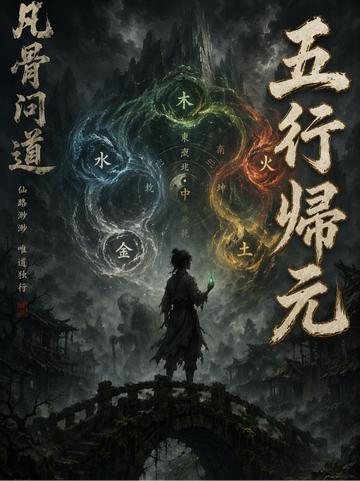
Lin Mu, a university student in Chinese literature from Earth and an enthusiast of Five Elements culture, transmigrates while studying the “Great Plan” chapter of the Book of Documents and the Hetu and Luoshu diagrams in class. An orphan at six, he waits ten years, only to be found to have a balanced Five Elements constitution: a useless body.
Of the eleven children in his village, three are admitted to the inner sects of cultivation sects, and seven to the outer sects. He alone is judged incapable of cultivating anything.
The only person who helps him is Zhou Banhu, a lonely old man who spent fifty-six years carrying rocks in a mine belonging to the Jianmu Sect. Injured and old, he is sent back to the village to wait for death. On his deathbed, the old man gives Lin Mu a damaged bamboo slip and a discarded, defective essence stone.
The bamboo slip bears the words: Five Elements Origin Return Art.
The Pavilion of Heavenly Principles says a balanced Five Elements constitution is worthless. Yet this cultivation art requires mastering all five elements.
Holding the scrap stone, Lin Mu senses the presence of vital energy for the first time in an abandoned mine tunnel. It is as faint as a spark, but undeniably real.
He has no perfect twelve rings, only five incomplete ones. He has no sect to shelter him, only the belongings left by a lonely old man. He has no complete cultivation art, only a fragment of the Wood section.
But he has the Five Elements of the Great Plan, the generative numbers of the Hetu, and a balanced Five Elements constitution that has been judged “worthless.”
Though the spark is faint, it can set the whole prairie ablaze.
It feels good to support newcomers