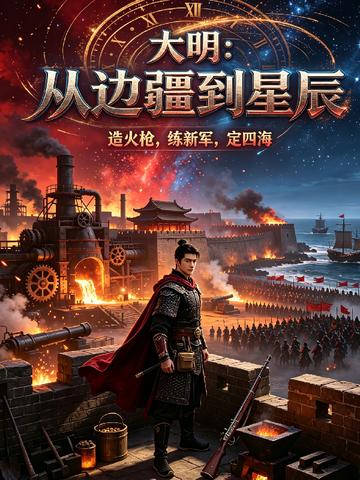
In the early years of the Wanli reign, Liang Linjun, a modern soul, unexpectedly arrives in a beleaguered Ming frontier garrison. Before him are pirates swarming like locusts and refugees crying out for food.
This is no age in which poetry and song can win fame. He chooses a path no one would dare imagine: entering the scorching workshops, improving the flintlock, and establishing a standardized weapons-production line. With cold steel and blazing gunpowder, he forges a modern army unlike any the world has ever seen.
From his dispute with Qi Jiguang over "strange inventions" in the military camp, to their astonishing joint victory in a bloody rout of the pirates; from a late-night game of strategy with Zhang Juzheng, and a startling discussion in which he uses modern fiscal theory to shore up the flaws in the reforms, to his arrival in the capital with overseas silver, sturdy ships, and powerful cannons, unleashing a mighty wave of "opening the seas and establishing prestige."
He does not fight alone. The missionary Matteo Ricci is so moved by his principle of "investigating things to extend knowledge" that he becomes the Ming Dynasty's eyes and ears in Europe. Wang Yangming, the master of the School of Mind, endorses his scientific spirit of "the unity of knowledge and action," imbuing the Industrial Revolution with an intellectual soul.
When the Ming's steam-powered ironclads cleave through the raging Indian Ocean, when trains thunder along the country's north-south arteries, and when the Dragon Flag flies at the mouth of the Thames, an unprecedented "empire on which the sun never sets" rises in the East. This is more than the rebirth of an empire. It is an epic leap from an agrarian civilization to an industrial one, from East Asian hegemon to global power, sounding the overture to an ancient civilization's journey toward the stars and seas.