[Comfortable article about medical superpowers/hospital workplace/reversal of human nature/case unit drama]
Introduction to the work:
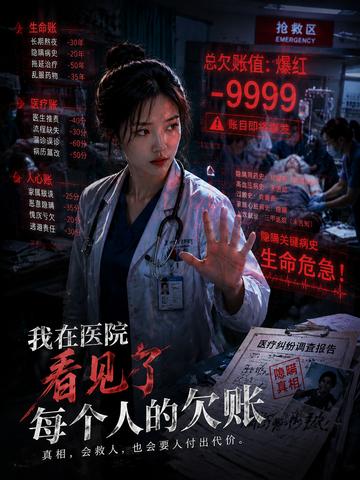
Lin Zhixia is a new resident doctor in the emergency department of the city's No. 1 Hospital. He comes from an ordinary background and has excellent academic performance, but has no background. On her first night on the job, she suddenly saw rows of debts on the patient that only she could understand: staying up late for a long time, concealing medical history, taking medications indiscriminately, delaying treatment, family members lying, and doctors shirk blame. All the debts recorded by the body, the truth, and conscience all lit up in front of her eyes. At first she thought she was hallucinating because she was too tired, until a patient who was treated as a common stomachache by her superiors went viral. The family deliberately concealed key medication history, and the patient almost went into shock. Lin Zhixia risked punishment beyond his level to promote inspection and rescue, and saved the patient, but also offended his immediate superior Zhao Mingchuan. Since then, she has been targeted by department factions, suspected by patients, ostracized by her colleagues, and constantly suffered backlash from her powers. She gradually understood that there were three types of debts: patients owed the body a debt of life, hospitals and doctors owed a medical debt of process and responsibility, and people owed guilt, malice, and debt. Behind every case, there is an unspoken truth. Some conceal their medication for the sake of traffic, some drag down the elderly to avoid support responsibilities, some tamper with medical records to blame others, and some are forced to remain silent even though they are clearly afraid. It can be seen that the debt is not without cost. The deeper she goes, the more frequent headaches, tinnitus, temporary blindness and nightmares become. As an old medical dispute surfaced, Lin Zhixia discovered that Zhao Mingchuan and department factions had jointly suppressed a serious missed diagnosis incident, and a similar chain of responsibility was about to repeat itself with new patients.