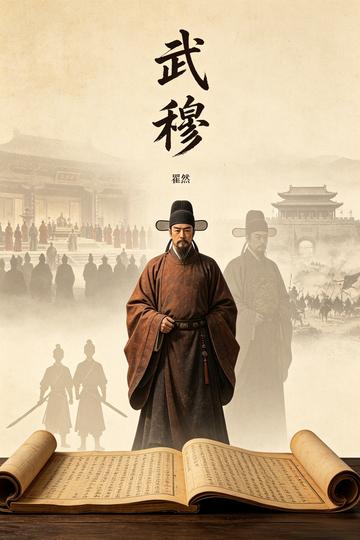
"Wu Mu" is a parallel history novel of about 110,000 words. It takes "Yue Fei did not die in Fengbo Pavilion" as the core assumption and rewrites the court and war situation in Shaoxing during the Southern Song Dynasty. On the 29th of the twelfth lunar month in the eleventh year of Shaoxing, Zhao Gou withdrew the death medal at the last moment. Yue Fei walked out of the prison, but entered a more dangerous chess game - he was promoted to the position of deputy privy envoy, and he investigated the military grain embezzlement case amidst Qin Hui's layers of traps, uncovering a chain of corruption from the Ministry of Household Affairs to the Qin government. He won the hearts of the people in Qizhou's fight against the epidemic, but was falsely accused of "buying people's hearts." He implemented the military reclamation system in Ezhou to turn swords into plowshares, but was questioned by Qingliu about his "defective personal ethics." At the same time, the new emperor of the Jin Kingdom ascended the throne, and the main combatant sent Sa Lihe to lead the Kaizima to raid Ezhou. Yue Fei's eldest son Yue Yun and Taihang's orphan Li Ruotong fought 300 men against 3000 cavalry at Qingshan Pass, completing the transformation from a boy to a general. The book takes Yue Fei as the core, Qin Hui as the counter-protagonist, and Yue Yun, Li Ruotong, and Yu Yunwen as the new generation group. In the dual-line narrative of the power struggle in the court and the blood and fire on the battlefield, it explores the boundaries of "loyalty", the true meaning of "martial arts" and the weight of "clear name". The golden sentence "A clear name is like wheat, its roots are in the soil" is the theme - in the face of setbacks, do not argue or get angry, just take root deeply. This is a work about how faith survives and is passed on in the cracks of power. Each chapter is rich in history and human depth.