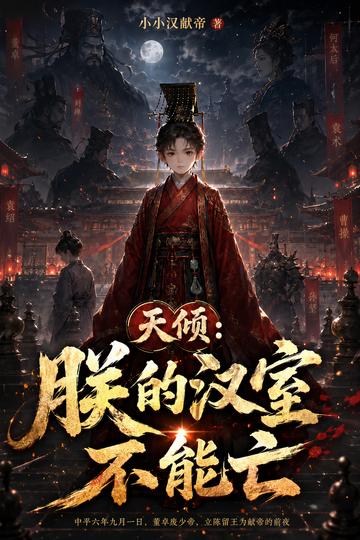
In the sixth year of Zhongping, a palace coup rocked Luoyang. Nine-year-old Liu Xie, the Prince of Chenliu, awoke in the cold wind on Mount Beimang.
He had been a young man in the future, studying the history of the Han and Wei dynasties. In an instant, his soul transmigrated into the body of the future Emperor Xian of Han, whom Dong Zhuo was about to place on the throne. The history books had already written his fate: deposed by Dong Zhuo, seized by Li Jue and Guo Si, controlled by Cao Cao, and finally forced by Cao Pi to abdicate, becoming the last puppet emperor of the Eastern Han.
But in this life, he refused to be a jade seal passed from hand to hand.
He had no army, no provisions, and no trusted followers. All he had was the body of a nine-year-old emperor, knowledge of history from a thousand years in the future, and the battered yet still weighty claim of the Han imperial house. Dong Zhuo's executioner's blade, Wang Yun's steely resolve, Jia Xu's cold calculations, Yuan Shao's aristocratic pedigree, Cao Cao's ambition and talent, Liu Bei's benevolence, and Sun Ce's sharp edge would all become forces he had to command or keep in check.
His task was not simply to kill a particular powerful minister, but to rebuild order in a collapsing age: preserve the court's records, rally the scholars, settle the Liangzhou troops, establish imperial farms, rewrite the secret edict hidden in a belt, use Cao Cao to pacify the realm, and prevent the Cao clan from usurping the Han.
When the flames of history once again spread toward Luoyang, he would make the name “Emperor Xian of Han” more than a posthumous title for a ruler who lost his country.
It would be the beginning of a restoration.