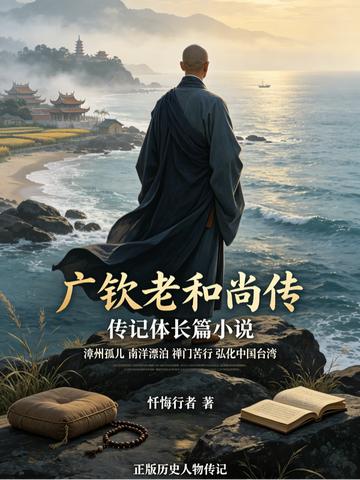
"The Biography of Old Monk Guangqin" is a full-length biographical novel based on the life of the modern Buddhist monk Guangqin (1892-1986). The book consists of seven volumes, 20 chapters, and 200 sections, with a total of about 2 million words. It uses literary style to panoramically present the complete life journey of this generation of holy monks, who is revered as "Monk Fuhu" and "Fruit Master", from a poor orphan to attaining fruition through practice.
The work starts from the countryside of Zhangzhou, Fujian, and follows the footsteps of the old monk Guangqin, spanning southern Fujian, Nanyang, and Taiwan, and running through the three eras of the late Qing Dynasty, the Republic of China, and modern times. From the shabby earth house in Huangcuo Village to the ascetic years at Chengtian Temple, from the crouching tiger in Qingyuan Mountain to the founding and popularization of Tucheng in Taiwan, the author uses delicate brushwork and broad vision to depict this eminent monk's tenacious Taoist heart tempered by impermanence and suffering, as well as his unique style of teaching sentient beings in the most plain and even simple way.
Different from the general biographies of eminent monks, this book does not focus on the accumulation of miracles and efficacious things, but returns to a core question: How can an illiterate "stupid monk" use the most sincere ascetic practices and the most ordinary chanting of Buddha to find a path of practice that directly points to the human heart? Throughout his life, he left no writings, no towers, no large sums of money, only a few baskets of daily conversations and a dying verse of "no coming, no going, no generation" - but it became a beacon in the hearts of countless practitioners.
The writing style of this book combines the rigor of biography with the vividness of fiction. A large number of details in the book are based on the oral records, quotations and related documents of the disciples of the old monk Guangqin. The dialogues and scene descriptions of the characters are literary.
Reader comments
The protagonist Huang Wenlai (Guang Qin) is a mortal hermit who practices asceticism. He has no family background, no martial arts secrets, and no noble people to tell him the truth. He starts as a low-level orphan. He does not rely on force to dominate the world, but uses asceticism and mental training as his martial arts:
As a young man, he endured and endured all the sufferings in the world without losing his original intention; in his middle age, he hid in the mountains and cultivated concentration, taming wild beasts and subduing his inner demons; in his later years, he entered the world and spread the Dharma, treating all beings equally, rich and poor.
He does not pursue fame, glory, or wealth. Others fight for fame and wealth, but he sharpens his mind to save himself and others. This is one of the few "anti-conventional heroes" in Jianghu literature. He does not have a murderous spirit, but stands at the top with his character. His character is not flat, and the more he reads, the more empathic he becomes.
The protagonist Huang Wenlai (Guang Qin) is a mortal hermit who practices asceticism. He has no family background, no martial arts secrets, and no noble people to tell him the truth. He starts as a low-level orphan. He does not rely on force to dominate the world, but uses asceticism and mental training as his martial arts: As a young man, he endured and endured all the sufferings in the world without losing his original intention; in his middle age, he hid in the mountains and cultivated concentration, taming wild beasts and subduing his inner demons; in his later years, he entered the world and spread the Dharma, treating all beings equally, rich and poor. He does not pursue fame, glory, or wealth. Others fight for fame and wealth, but he sharpens his mind to save himself and others. This is one of the few "anti-conventional heroes" in Jianghu literature. He does not have a murderous spirit, but stands at the top with his character. His character is not flat, and the more he reads, the more empathic he becomes.