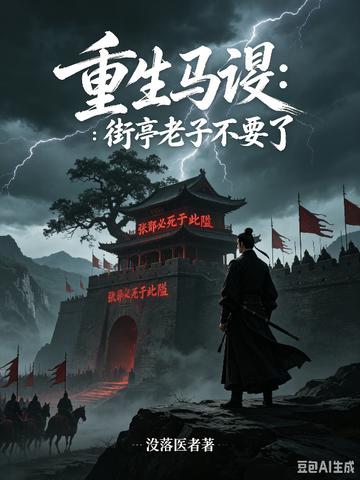
In the sixth year of Jianxing's reign, Ma Di returned to the street pavilion.
The world scolded him for talking about war on paper and sabotaging the Northern Expedition by abandoning water and mountains. Wang Ping persuaded him to set up camp on the road, while Zhang He waited for him to die in the valley.
But no one has discovered: the street pavilion is as open as a flat river, and it is not a natural barrier to protect against enemies; Longguan, sixty miles away, is the eternal throat that locks Longshan.
In his first rebirth, he abandoned his place of death and headed for Xiong Pass, blocking Zhang He's 40,000-strong cavalry heading westward in one step.
He filled in the only deadlock in the Ziwu Valley strategy for Wei Yan: Zhao Yun's suspected troops held Cao Zhen, and the main force pushed to close Longyou. Wei Yan's light troops inserted Chang'an, and backhand locked Tongguan, Wuguan, and Sanguan.
In the eyes of the world, the "strange conspiracy of a lonely man gambling his life" has become a conspiracy with layers of closed loops and no solution.
The full text is based on "Three Kingdoms", "Wei Lue", "Shui Jing Zhu" and "Taiping Huanyu Ji", anchoring the precise sequence of the battle in the six years of Jianxing, and rigorously deducing the situation of the Longshan-Guanzhong geopolitical situation, Cao Wei's national military deployment, and the Shu-Wu alliance.
This is not a cool article, but an official historical strategic review of the millennium-old fallacy.
Longguan's natural danger, Ziwu Yang's plan, Wei Yan's handsome talent, and the four-line encirclement - every step has its origin.