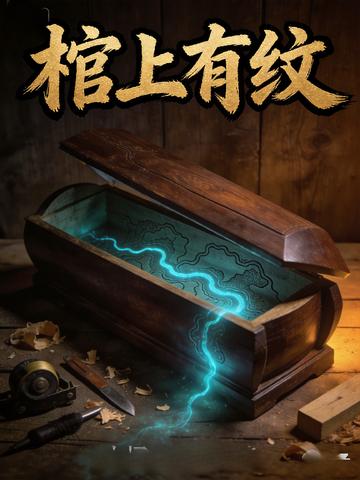
> Chen Shouzhuo, the only coffin maker in the town, has a craft passed down from his ancestors - carving "guiding patterns" on the inner wall of the coffin, which is said to help the deceased find the way and avoid going astray.
>
> He has made coffins for countless people, but the one where his wife died ten years ago has a crack in the lead. He always felt that she didn't leave well.
>
> Until a young woman named Lin Suyi came to the door: "I want to make myself a coffin."
>
> Shouzhuo refuses. But the date Su Yi left behind was the anniversary of his late wife's death.
>
> A living coffin leads to an old score from thirty years ago - two women died on the same day, only one of the two coffins was delivered, and the remains were buried under the road without anyone asking. The guide lines were carved deeper and deeper, the wood grain began to extend on its own, and the plain clothes had the same lines as the coffin boards.
>
> Shouzhuo followed the pattern and dug up three remains, as well as a secret that had been hidden for thirty years: the crack in his late wife's coffin was not a fault in his craftsmanship - it was her blocking a path he shouldn't have taken.
>
> It took him ten years to understand that the road leading to the road was not the Huangquan Road.
>
>It's the way home.
---
Reader comments
Book Review of "The Pattern on the Coffin"
The coffin maker doesn't believe in ghosts, but he believes in patterns. Chen Shou spent his whole life carving guide patterns - hidden paths on the inner wall of the coffin to guide the deceased on their way home. It wasn't until a young woman named Lin Suyi came to the door carrying a coffin and asked him to carve a coffin for a living person that the lines really started to turn.
The most powerful thing about this story is not the monsters, but the "people". The guide lines were carved deeper and deeper, and 30-year-old cases were uncovered layer by layer: the burial that was torn in half, the carved patterns on the stone, and the last guide for her daughter made by a mother who did not know how to carpenter. The background of all supernatural beings is obsession, and the outlet of all obsessions is craftsmanship. When Shou Zhuo's apprentice Xiao Man carved the pattern independently for the first time, the wood grain naturally extended - this was not a talent, but the road was waiting for a pair of hands that could catch it.
Shouzhuo is not a hero, he is an old carpenter. The way he solved the problem was to put the wood against each other: the seams of the coffin, the lines of the coffin, the paths of the living and the dead. In the last chapter, he put away his knife and made a new coffin, without any guide lines - "Some people can walk their own way." This sentence is light, but it holds the weight of the entire book.
After all, "The Pattern on the Coffin" is not about how to get rid of the dead, but how to let go of the living. The road is open, no need to send it. No one needs to guide you.
Book Review of "The Pattern on the Coffin" The coffin maker doesn't believe in ghosts, but he believes in patterns. Chen Shou spent his whole life carving guide patterns - hidden paths on the inner wall of the coffin to guide the deceased on their way home. It wasn't until a young woman named Lin Suyi came to the door carrying a coffin and asked him to carve a coffin for a living person that the lines really started to turn. The most powerful thing about this story is not the monsters, but the "people". The guide lines were carved deeper and deeper, and 30-year-old cases were uncovered layer by layer: the burial that was torn in half, the carved patterns on the stone, and the last guide for her daughter made by a mother who did not know how to carpenter. The background of all supernatural beings is obsession, and the outlet of all obsessions is craftsmanship. When Shou Zhuo's apprentice Xiao Man carved the pattern independently for the first time, the wood grain naturally extended - this was not a talent, but the road was waiting for a pair of hands that could catch it. Shouzhuo is not a hero, he is an old carpenter. The way he solved the problem was to put the wood against each other: the seams of the coffin, the lines of the coffin, the paths of the living and the dead. In the last chapter, he put away his knife and made a new coffin, without any guide lines - "Some people can walk their own way." This sentence is light, but it holds the weight of the entire book. After all, "The Pattern on the Coffin" is not about how to get rid of the dead, but how to let go of the living. The road is open, no need to send it. No one needs to guide you.