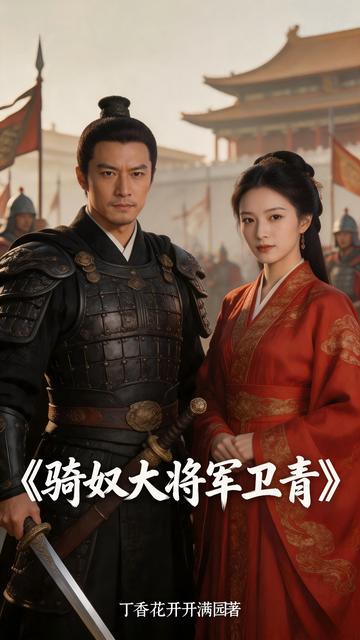
In 129 BC, an illegitimate riding slave who had fed horses and been whipped in the Pingyang Marquis Mansion, in a desperate situation when the Han Dynasty's four armies were defeated in three directions, led his troops to Dragon City, the holy place where the Xiongnu worshiped the heavens, and beheaded 700 people. The Han Dynasty had been humiliated for hundreds of years. At that moment, he used a blood-stained knife to tear open a gash.
His name is Wei Qing. The courtesy name is Zhongqing.
His origin was the humblest footnote of the empire: an illegitimate son born from an affair between a county official and a maid from the Marquis. Even his surname was borrowed. His greatest hope was not to be beaten.
His rise is the most incredible legend of this empire: from a cavalry slave to a bodyguard, from a bodyguard to a cavalry general, and from a cavalry general to a most human minister, the Great General Sima fought against the Huns seven times, and won all seven battles without losing a single one. He made a sentence that will be remembered by future generations: There is no royal court in Monan.
However, deep in his heart, there was always an unsheathed sword.
He did not keep any retainers, did not form cliques for personal gain, and was always as deferential to the emperor as the young man who led the horse in the beginning. He concealed the fact that Li Gan injured himself because Li Guang was the one who climbed out of the dead together with him. He personally trained Huo Qubing and watched the young man's brilliance surpass his own, but he said nothing and only kept an old shirt locked in the box.
He spent his whole life doing one thing: making Wei Qing the most trusted figure for His Majesty.
But where was the true self of the little boy talking to the horse in the stable, the boy secretly crying in front of his mother's grave, and the general gazing at the sky in the wilderness of Mobei?
This is a story about tolerance, about glory, and about the price of fate.