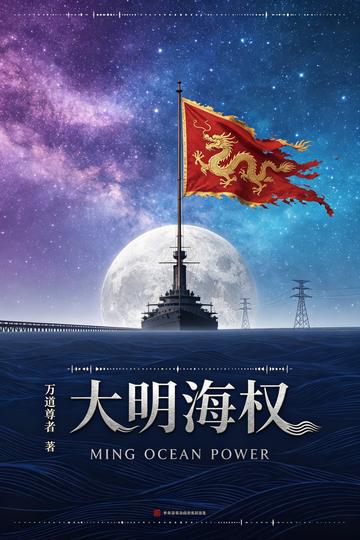
Chen Yuan, a modern naval strategy researcher, accidentally traveled through time and became Zhu Yunwen, the newly crowned Jianwen Emperor. Faced with the deadlock of reducing the vassal, he gave up his reckless actions and boiled the vassal with warm water by "purchasing military rights, commercial concessions, and overseas fiefdoms", transforming King Zhu Di of Yan into a pioneer in Beiyang, and resolved the Jingnan crisis without bloodshed.
Subsequently, he anchored the country's destiny in the ocean with a forward-looking vision: he reused Zheng He's seven voyages to the Western Ocean, sailed around the world, and controlled the route from Malacca to the Indian Ocean; he sent Zhu Di to conquer Japan eastward and explore Alaska northward to establish the "New Ming Dynasty" on the west coast of America; he developed gold and silver mines in Australia, colonized the South Ocean, and formed a trade empire covering the Pacific and Indian Oceans.
Domestically, the study of physics was simultaneously promoted, steam engines, telegraphs, railways, and firearms were developed, igniting the industrial revolution. Institutionally, it established a parliament, implemented a constitutional monarchy, abolished slavery, granted women the right to vote, and completed the transformation from an inland dynasty to a maritime empire.
After the four dynasties of Jianwen, Yonghe, Xuanhe, and Hongzhi, the Ming Dynasty led the world into the electrical age, information age, and space age. Nuclear weapons, artificial satellites, moon landings, and the Internet were born one after another. Humanity stands on the threshold of interstellar civilization.
Zhu Yunwen left a legacy before his death: "The road to the Ming Dynasty, from the ocean to the stars, will never end." Four hundred years later, the treasure ship that sailed out of Nanjing has turned into a starship flying to Mars. A time traveler changed the direction of a civilization.