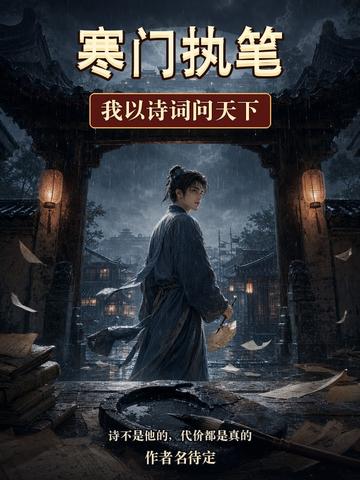
Shen Yanzhou, a modern ancient books editor, opened his eyes and became a poor scholar from a small county in the south of the Yangtze River during the Dasheng Dynasty.
His father died young, his mother was seriously ill, his creditors broke down on his door, and he was still burdened with the stigma of cheating in the county examination. If the money is not paid within three days, even the mother will have to pay off the debt.
In order to survive, he could only take out the Tang poetry and Song lyrics that he had memorized in his previous life: a couplet written in a restaurant in exchange for medicine money, an amazing poem outside the county school, and a booklet of poetry in bookstores spread throughout the south of the Yangtze River. From a debt-ridden scholar to an upstart scholar, he relied on ancient articles to gradually open the door to the imperial examination, officialdom and world order.
But the more famous the poem is, the closer the question becomes. Old cases of the Gu family, county government files, quotas for poor families, and the capital's power bureau came one after another. Everyone wanted to know: were these poems really written by him?
The poem is not his, but the price is real. When a borrowed talent becomes evidence to judge him, Shen Yanzhou must use what he has really done to write his own life.
Reader comments
The author is very knowledgeable!
I saw a similar plot yesterday, but the writing was shallow. Your five-character rhyme is quite ancient and superior. Look again.
The author is very knowledgeable!
I saw a similar plot yesterday, but the writing was shallow. Your five-character rhyme is quite ancient and superior. Look again.
It's very depressing and not easy.