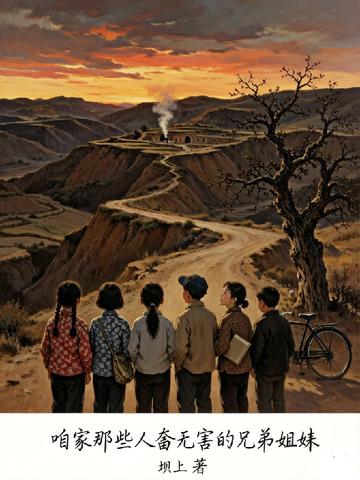
Ma Yindi was most afraid of people asking her name in her life.
Introducing Di, attracting his younger brother. Before her, the eldest sister was called Zhaodi, and the second sister was called Laidi. Each one was more straightforward than the other. After her, the fifth sister was named Pandi. After three years of waiting, she finally had the sixth child, the son her mother had sacrificed her life for.
Six children, four women and two sons. In Majiagou on the Loess Plateau in northern Shaanxi, this is a very common configuration. But underneath the ordinary lies the grievances of four women for half their lives, the guilt that two sons can't get rid of, and the struggle that a mother can't express.
The eldest sister, Zhaodi, has become the second pillar of the family; the second sister, Laidi, confronts fate head-on with a thorn in her body; the third sister, Yindi, is a "naughty person" who doesn't fight or fight, but has become everyone's most reliable support; the fifth sister, Pandi, studies hard just to prove that women are no worse than sons. Two younger brothers - Jianping, who is spoiled, has been struggling around and owes a lot of debt; Jianwei, who is silent, has been burdened with the "old knot" and cannot stand straight for the rest of his life.
In thirty years, from cave dwellings to county towns, from Huangtu Slope to provincial capitals. The whole family had quarreled, made noises, turned over tables, collected money, stayed overnight, and cried in each other's arms.
This is a story about partiality and reconciliation, debt and repayment, acceptance of fate and failure to accept fate.
It is also the unspoken account of every family with many children.