The history of human civilization is essentially an evolutionary history of continuous improvement in cognitive abilities. Today, the breakthrough development of artificial intelligence, especially large language models, is starting a new round of revolution in the history of human cognition, bringing mankind into a new cognitive era of human-machine integration.
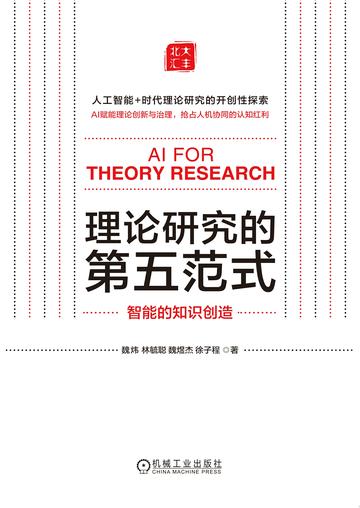
"The Fifth Paradigm of Theoretical Research" focuses on the transition of AI from "theory user" to "theory creator", and directly attacks the core pain points of traditional theoretical research such as low induction efficiency, vague concept definitions, and slow causal verification. Relying on core frameworks such as implicit knowledge graphs, principles of consciousness and free energy, and dual-cycle innovation mechanisms, the author team led by Wei Wei is divided into four parts with a total of 12 chapters. From the intelligence level evaluation system to the construction of theoretical organisms, from theoretical selection and optimization to interdisciplinary governance, it comprehensively presents the complete path of AI-driven theoretical innovation.
The first part is the general introduction: it explains from a macro level how AI changes the methodology of theoretical research, and establishes the core theme of the paradigm shift from humans creating theories alone to human-machine collaborative research.
The second part focuses on the exploration of innovation mechanisms: an in-depth discussion of the mechanism and innovation paths of AI in theoretical research.
The third part focuses on cognitive basic research: revealing the deep mechanism and technical foundation of AI theoretical capabilities.
The fourth part is dedicated to the expansion of application practice: focusing on the practical application and industrialization prospects of AI theoretical capabilities.
Combining 29 development practice cases such as enterprise organization reconstruction and medical diagnosis, "The Fifth Paradigm of Theoretical Research" provides scientific researchers, corporate decision-makers, etc. With an implementable human-machine collaboration methodology, helping to break through cognitive boundaries and seize the dividends of theoretical innovation in the intelligent era. It is a must-read guide for understanding the reshaping of knowledge production models by AI.