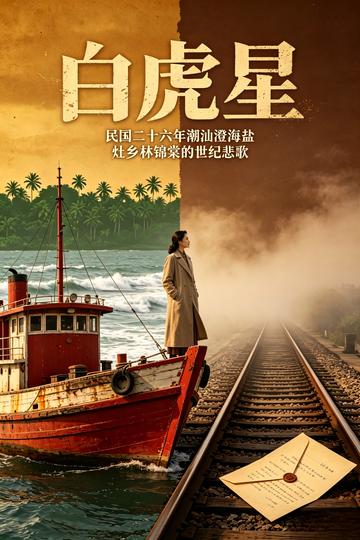
In the twenty-sixth year of the Republic of China, Lin Jintang from Yanzao Township, Chenghai, Chaoshan, was "sold" by his father to the Chen family in Penang for two hundred oceans, as a way to celebrate the second son, Chen Guangyu, who had been ill for a long time. On the red-headed boat, she met and got to know Xu Mingyi, a young man from Jieyang who had been on the same boat, and they agreed to escape together after arriving in Nanyang. When the ship arrived at the Strait of Malacca, a plague was rampant. Mingyi was thrown into the sea as a patient by the shipowner. Jintang watched helplessly as he sank into darkness.
Jintang married into the Chen family, but Guangyu vomited blood and died on the wedding night. Before his death, he asked her to find his eldest brother Chen Guangyao, who was lost in Nanyang. She was considered an unlucky person by the Chen family and was assigned to work as a supervisor in a rubber plantation in Balik Pulau. When World War II broke out and the Japanese army occupied Malaya, Guangyao narrowly escaped death on the Thailand-Burma Death Railway and returned to Penang dragging his broken leg, only to seal himself in scars and shame. Two people crushed by fate were forced to depend on each other amid gunfire and famine in the rubber plantation.
After the war, a mysterious letter from Belitung, Indonesia broke the calm: Xu Mingyi was not dead. Jintang must make a choice between a deep-rooted old dream and a heavy kindness. It took her twenty-six years to travel through Penang, Aceh and Chaoshan, and finally understood that some promises are meant to be kept, some promises are meant to be kept, and some promises take a lifetime to repay.
The novel takes Chaoshan overseas Chinese batches, red-headed boats, rubber plantations and the Death Railway as its latitude and longitude, and tells a century-old tragedy that spans World War II and the Cold War, Southeast Asia and the homeland. This is a story about waiting, lies and reunion, and a love letter that will never be opened.