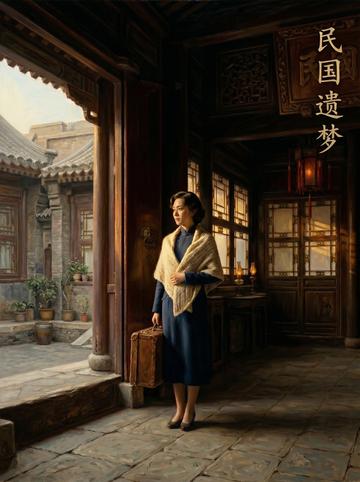
1925, Tianjin Wharf.
Shen Yanqiu came back from England, carrying a suitcase and a letter from an old lover. The letter said: "Tianjin is waiting for you."
She thought that was the beginning of a reunion. Only when I arrived did I realize that Duan Zhenting was no longer a young man reading Rilke by the London River - he was a warlord in Tianjin, with a concubine with four bedrooms, a deep house and a large courtyard, and the sound of wooden fish never stopped. And she was the sixth person he didn't dare to mention in his letter.
The four wives told her in one way: this is not "home", but a besieged city. The eldest aunt was too busy settling accounts, the second aunt was too happy to sing opera, the third aunt was too reciting Buddhist scriptures, the fourth aunt too - the fourth aunt was looking at her as if she was recognizing a similar person, but also as if she was feeling sorry for her.
Shen Yanqiu has lived in this house for more than 20 years. From the female students studying in England to the sixth aunt, from the typewriter to the account book, from the library window to the rain in Taipei. She tried to live by books, by silence, and by running away. Finally, she understood: this house was not her prison—her prison was what she thought was "the only way to go."
An epic of women in the Republic of China spanning 1925-1949. About a woman who "shouldn't have married in" and a love that "shouldn't have started".