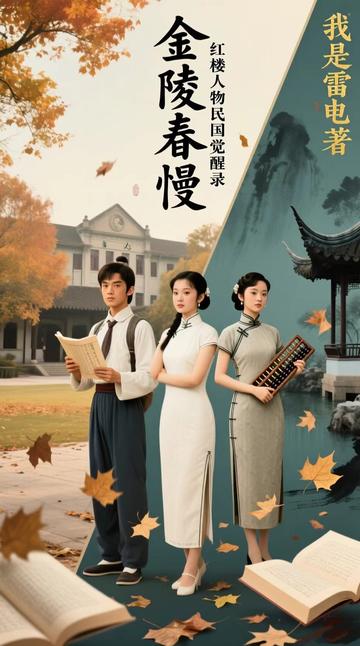
1935, Jinling University.
Jia Baoyu, a student from the Department of Philosophy, suddenly wakes up from his past life memory: he was the second master Bao of Rongguo Mansion, and he had a sister Lin who loved to cry and write poems.
When he rushed into the Chinese Department classroom and grabbed the pale and coughing girl Lin Wanci, he knew from her frightened tearful eyes: She also remembered.
This is not an isolated case.
Xue Baochai, a rational and thoughtful medical student, remembered the "good match" when touching the golden lock; Wang Xifeng, the queen of law school, regained her instinct for power in the student union election; Jia Tanchun, who joined the revolution, Shi Xiangyun, who went to the battlefield, Shanghai star Qin Keqing...
The twelve beauties of Jinling are all awakened.
But this is not the Grand View Garden. This is China in the 1930s - the Japanese army is pressing down on the country, the revolutionary wave is raging, and vernacular and classical Chinese are in fierce conflict.
Can Daiyu's poems survive the flames of the Anti-Japanese War?
Baochai's "good wind relies on strength", which era of wind should he borrow?
Is Wang Xifeng's strategy still valid in the face of law and guns?
And can Baoyu keep his "unfeeling" in the crisis of national subjugation?
From the campus poetry club to Southwest Associated University, from the fall of Nanjing to the foggy city of Chongqing,
This is a collective journey of classical souls through modern China.
It is also a majestic epic about love, ideals and family and country.
"We are not repeating tragedy."
"We want to rewrite everyone's destiny in this greater tragedy." Updated at 15:15 every afternoon, so stay tuned.