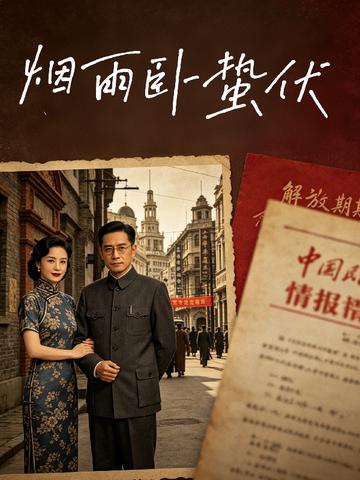
The novel opens in 1951, in an interrogation room at a detention center run by the Nanjing Military Control Commission. Its story revolves around the repeated request of Zhou Meilin, a female Kuomintang secret agent: “Go find the Communist who loves lilacs.” This seemingly deranged plea is actually a key that leads readers into the treacherous waters of the intelligence war between the Kuomintang and the Communists. Through the hidden pocket in Zhou Meilin’s qipao, the Yan’an Anti-Japanese Military and Political University badge concealed in a fountain pen nib, and the clock ticking on the interrogation room wall, the author builds a maze of codes spanning two regimes. When investigators discover that “Lilac” was the codename of the most mysterious double agent in the history of the Military Statistics Bureau, all the clues suddenly point to a scholar surnamed Zhang, an early member of the Chinese Communist Party who returned from the United States in 1940. Reflected in the lenses Zhou Meilin repeatedly wipes at the detention center are not only her own haggard face, but also Morse code intercepted at the Changming Bridge post office, a miniature roll of film hidden among the gears of a state-run factory, and invisible ink on the bookplates of university professors. As an archivist at the Military Control Commission writes “No such person found” in the “Lilac” file, the lilacs outside the window quietly bloom, tinting the blood-red dawn pale purple. That is the very color of the potassium cyanide hidden beneath the lining of Zhou Meilin’s rouge box.