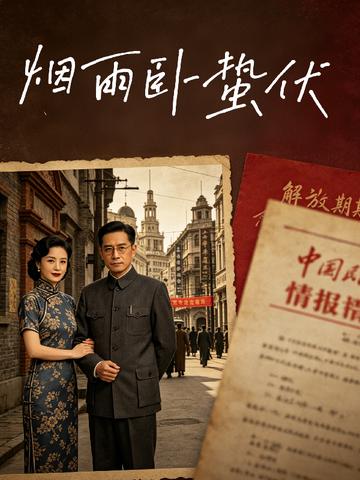
The novel starts from the interrogation room of the Nanjing Military Control Commission Detention Center in 1951, and revolves around the repeated mention of "the Communist Party looking for lilacs" by Zhou Meilin, a female military control agent. This seemingly crazy request is actually a key that leads readers into the hidden turret of the intelligence war between the Kuomintang and the Communist Party. The author uses Zhou Meilin's cheongsam secret pocket, the Yan'an Anti-Japanese University emblem hidden in the pen tip, and the ticking clock on the wall of the interrogation room to construct a coded maze spanning the two regimes. When the investigators discovered that "Lilac" was actually the most mysterious double-agent codename in the history of military unification, all clues suddenly pointed to a scholar named Zhang, an early member of the Communist Party of China who returned from studying in the United States in 1940. The lenses Zhou Meilin repeatedly wiped in the detention center reflected not only her haggard face, but also the intercepted Morse code at the Changmingqiao Post and Telecommunications Bureau, the microfilm hidden between the gears of a state-owned factory, and the invisible ink on the bookplates of university professors. As the Military Control Commission archivist wrote "No such person found" in the "Lilac" file, the lilacs outside the window were blooming quietly, dyeing the bloody dawn into lavender - that color was exactly the color of the potassium cyanide hidden at the bottom of the rouge box by Zhou Meilin.