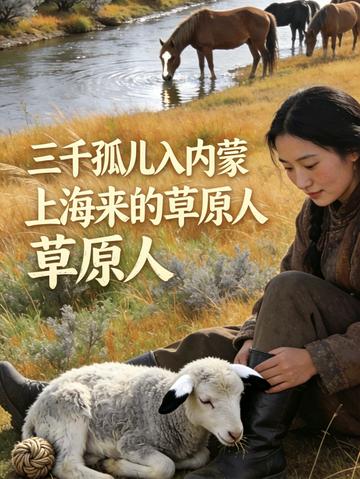
In 1960, three thousand orphans from the south traveled by train across half of China to the grasslands of Inner Mongolia.
Four-year-old Su Jinxiu is one of them. She was as thin as a piece of grass and didn't even dare to drink milk tea.
The herdsman Qimuge opened his leather robe and wrapped the trembling little girl in his arms. She sold her dowry silver bracelet in exchange for cows, rode on a snowy night dozens of miles away to collect herbs, pointed to her heart and said to her - "You were not born into Eji's belly, but you were born into Eji's heart."
From then on, she got a new name: Qiqige, the flower on the grassland.
From milking cows, riding horses, and rolling felt, to delivering the first lamb, going to college, and returning to the grassland to work as a veterinarian, Qi Qiqi took root in this land. The little lamb Chagan she delivered by herself has been with her for most of her life. The wooden figure cut by her father was as smooth as jade with the sweat of her palms. The morin fiddle has been played for decades, and the strings have been changed one after another.
But over in Shanghai, a letter came from my aunt. The letter said that her mother-in-law was still calling her name when she left.
Where are a person's roots? Is it the south where she was born, or the grassland where she was raised? This is a question that Qi Qige spent his whole life answering.
This is a novel based on the true history of "Three Thousand Orphans Entering Inner Mongolia". About how maternal love transcends blood lines, about how a bowl of milk tea, a cow, a group of people and a piece of grassland take over a child's life. ^_^
Reader comments
I am from Inner Mongolia. When I hear this story, I feel so warm and it feels like I have returned to my childhood.
I am from Inner Mongolia. When I hear this story, I feel so warm and it feels like I have returned to my childhood.
Very delicate writing