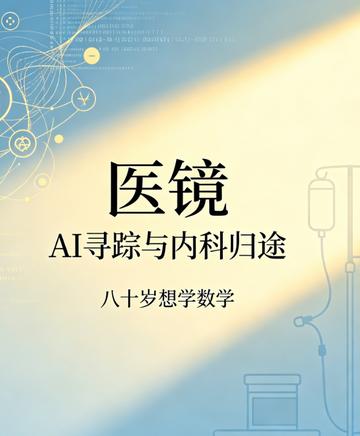
Su Yan is a clinical medical student in a five-plus-three program, with no connections, no resources, and no shortcuts to rely on. In his fifth year, during his internship, his medical records are torn to shreds by his supervisor. Late one night, a future AI named “Mirror” silently appears. It communicates in faint gray text and does not diagnose patients; it only helps define the limits of judgment.
From learning to read medical literature in three passes to quality-checking medical records, from earning his first meager income by sharing medical knowledge to gradually building a high-performance computer, a dual-monitor setup, and a private research space, Su Yan spends three years in residency training building his confidence piece by piece, one device at a time.
But Mirror's true mission goes far beyond that: tracing diagnostic errors hidden in 1,247 medical records, identifying tampered diagnostic standards, and uncovering how data from a single center was extrapolated into national guidelines. When all six bias models are finally closed, Mirror switches to read-only mode, leaving behind one last message: “Goodbye, observed one.”
Su Yan folds a sticky note into thirds and slips it into the left pocket of his white coat, beside his shield pin. On the night the acceptance notice from a top journal arrives, he sits at his desk by the window and adds one more line to his journal: The observed is no longer a recipient. The observed has become the gatekeeper.
A medical coming-of-age novel grounded in clinical details, down to extrapolation bias in liver biopsy complication rates, and restrained in its storytelling, with every heartbeat measured by the pulse in the radial artery. Not a word wasted, not a moment out of place: just medical records, data, and a man who has found his direction and will never turn back.


Let me talk about the conclusion first. This book is highly recommended. From the perspective of a graduate student, the author writes about how a doctor gradually grows from a medical student to a doctor, what he goes through in the process, how to make progress, how to improve, etc. The book involves a lot of professional knowledge, and it can be seen that the author must have experienced it personally. The current work mainly focuses on the growth of the protagonist, with various clinical cases interspersed in the middle. It is very fascinating to read one chapter after another. The writing style is also very good, and the reading experience is very good. Overall a great piece about medical students! Hope there will be more updates.
Is this the romance of medical students? So beautiful